Nagaoka, Japan’s Forgotten Capital
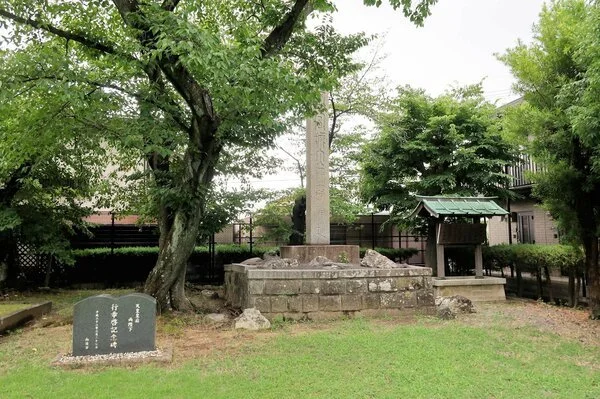
Stele erected in 1895 to mark the presumed location of the Nagaoka palace’s audience hall in Mukō city. Kyoto Shinbun.
The Nagaoka capital (Nagaokakyō) was constructed in 784 in the Otokuni district of Yamashiro province by order of the late eighth-century sovereign Kanmu. However, after a period of just ten years, the capital was abandoned and Kanmu relocated his court and capital to Heian.
The history of the Nagaoka capital up until 792 was recorded in the closing chapters of the Shoku Nihongi, an official court chronicle presented to Kanmu in 797. The events of the final years of the Nagaoka capital’s existence were covered by the opening chapters of the Nihon kōki. Unfortunately, the first four chapters of this work, which covered the abandonment of the Nagaoka capital and the move to the Heian capital, are lost. Parts of the historical records contained in those missing chapters of the Nihon kōki have been preserved in the Nihon kiryaku, a Heian-period summary of the Rikkokushi; in the Ruijū kokushi, a late ninth-century work in which material drawn from the official histories is arranged by subject; and in the Fusō ryakki, a late Heian-period Buddhist history of events up to 1094. In the Tokugawa period, a further attempt was made at restoring the missing parts of the Nihon kōki in the Nihon isshi.
Because of the lacunae in the historical records, the short period during which the Nagaoka capital was in use, and a lack of physical evidence for the existence of the capital, the Nagaoka capital soon took on the image of a phantom capital or a temporary capital. It was believed that the Nagaoka capital consisted merely of an imperial palace with some necessary urban facilities but was not a fully planned Chinese-style capital as were, for example, the Nara and Heian capitals. As a result, the location of the Nagaoka palace had already become unclear by the Kamakura period. It was only during the Meiji period that the location of the Nagaoka palace gradually became more accurately known again. At the end of the nineteenth century, Yumoto Fumihiko pinpointed the location of Kanmu’s audience hall (daigokuden) in the ‘Daigokuden’ quarter of Kaide in Mukō city. Based on Yumoto’s findings, a stele commemorating the Nagaoka palace was erected on the presumed location of the imperial audience hall on the occasion of the 1100th anniversary of the transfer of the capital to Heian.
Research on the Nagaoka capital, rather than the palace, started only 1908, when the historian Kita Sadakichi published a series of four articles entitled Nagaoka sento kō [Thoughts on the transfer of the Nagaoka capital]. For the first time, the Nagaoka capital was recognized as a real Chinese-style capital consisting of a palace area surrounded on three sides by an urban area. Kita also presumed that its extent was no less than the scale of other capitals such as Nara and Heian.
Another forty-five years passed before an attempt was made at systematically excavating the capital’s remains, partially because researchers assumed that the chances of finding remaining traces were slim, given the short period of time during which the Nagaoka capital had existed. At the instigation of historian Nakayama Shūichi, a resident of Mukō city, the first excavation finally took place at the end of 1954.
— Adapted from the introduction to Ellen Van Goethem, Nagaoka, Japan’s Forgotten Capital
The Book
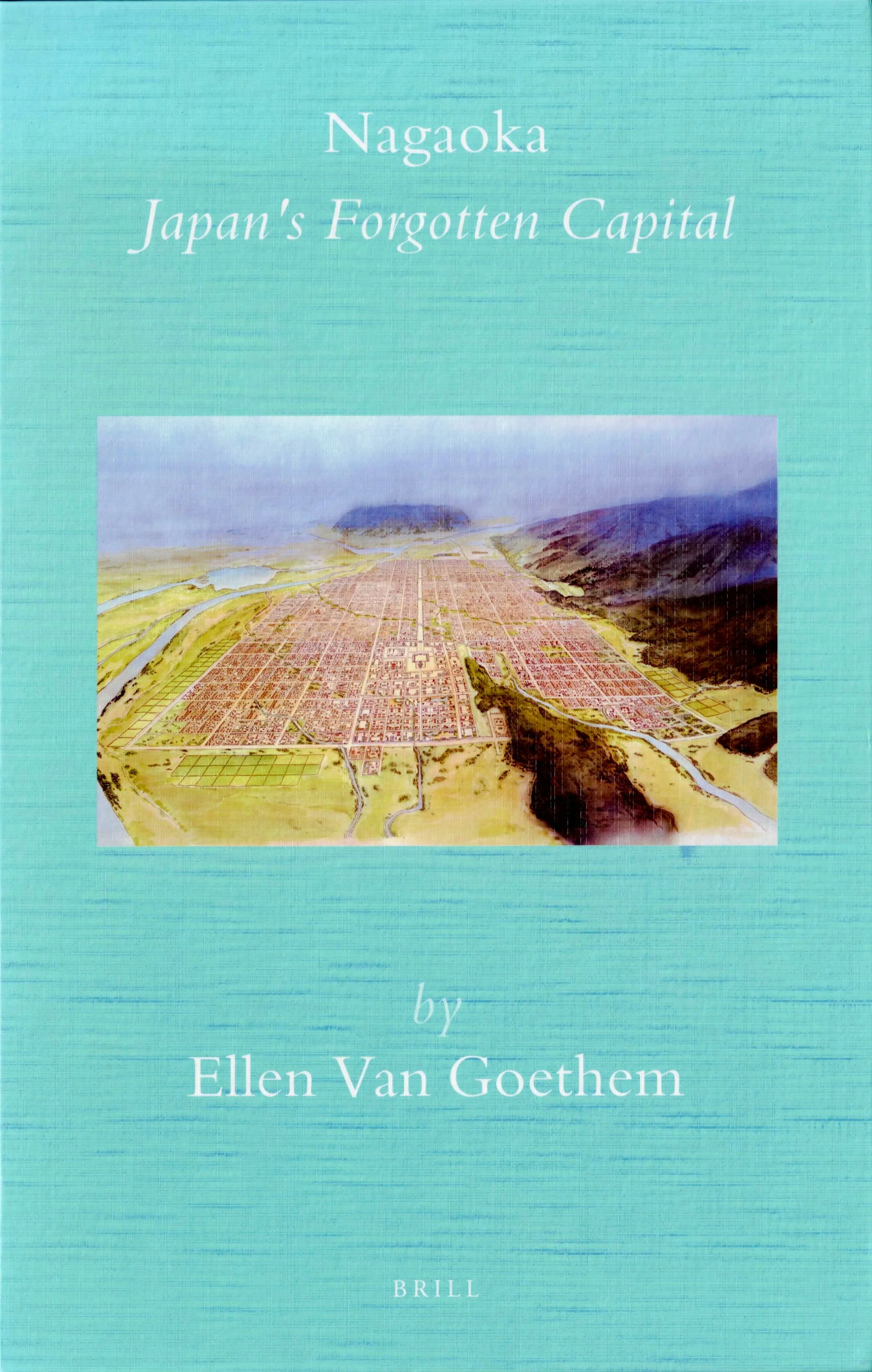
Nagaoka: Japan’s Forgotten Capital was originally published in 2008 but is now available for free download via the publisher’s website.
This was the first work to deal comprehensively with the historical and physical aspects of the Nagaoka palace and capital, which were constructed in the late eighth century at the order of Kanmu Tennō, but abruptly abandoned after only ten years.
New research and the information yielded by decades of excavation made possible this fresh reassessment of conventional theories of the construction and layout of Nagaoka, as well as the life and reign of its founder. It also examines the motivations behind Nagaoka's establishment and abandonment within the context of Kanmu's reign and personal convictions. In broader terms, this volume deals with the process of capital building in late eighth-century Japan, and the links between the Nara and Heian capitals.
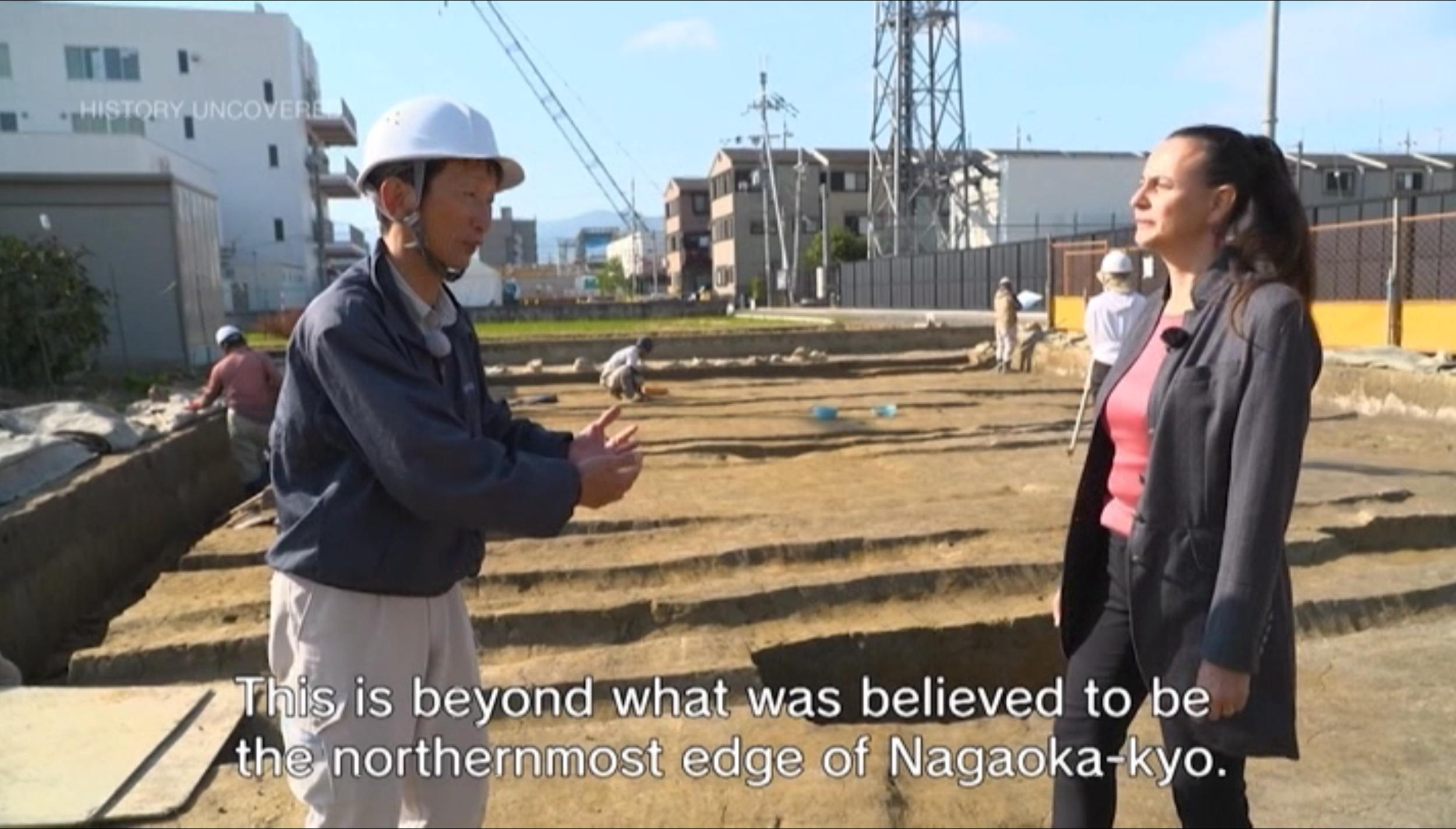
At an excavation site with Minami Takao of the Kyoto City Archaeological Research Institute for NHK World’s History Uncovered: The Secrets of Kyoto – Thousand-Year Capital
Updates to the Book
Excavations of the Nagaoka capital have continued at a steady pace since the publication of my book and have resulted in a number of new discoveries.
Among other things, the grid plan of the city continues to evolve and it now appears that residential blocks were planned north of what was once thought to be the capital’s northern boundary.
The dating of specific sectors within the palace area and the division into distinct construction phases based on roof tile analysis may also be up for revision.
If you are interested in these topics, you should take a look at Kunishita Tamiki’s Nagaokakyō no rekishi kōkogaku kenkyū 長岡京の歴史考古学研究 (2013) or publications by Umemoto Yasuhiro, the current head of the Mukō City Center for Buried Cultural Properties.
Publications
Nagaoka, Japan’s Forgotten Capital (Leiden: Brill Academic Publishers, 2008; 2010 e-book edition; 2022 Open Access edition).
Encyclopedia entries on Nara and Naniwa/Osaka in Grove Art Online (Oxford University Press).
‘Asuka-Fujiwara through Foreign Eyes – Research from Abroad,’ in Sekai ni tsutaetai ‘Asuka, Fujiwara no miryoku’ kinen kōen shiryōshū 世界に伝えたい「飛鳥・藤原の魅力」記念講演資料集 (Research Institute for Ancient Japanese Studies, Meiji University and Committee for the Promotion of UNESCO Recognition of the Asuka and Fujiwara Area, 2016), 17–27.
‘Asuka, Fujiwara’ sekai isanka ōen essē「飛鳥・藤原」世界遺産化応援エッセー Asuka-Fujiwara: The Beginning of Japanese History,’ in Sekai ni tsutaetai Asuka, Fujiwara no miryoku kinen kōen shiryōshū 世界に伝えたい飛鳥・藤原の魅力記念講演資料集 (Research Institute for Ancient Japanese Studies, Meiji University and Committee for the Promotion of UNESCO Recognition of the Asuka and Fujiwara Area, 2015), 35.
‘Cultural Borrowing and Adaptation in Ancient Japan: Capital Cities,’ Proceedings of the International Symposium on Japanese Studies “Japanese Cultural and Linguistic Identity” (Bucharest, Bucharest University, Center for Japanese Studies, 2011), s.p.
‘The Status of Descendants of the Baekje Kingdom during Emperor Kanmu’s Reign,’ Korea Journal 47:2 (Summer 2007), 136–59.
‘The Construction of the Nagaoka Palace and Capital – Mokkan 木簡 as a Historical Source’, in Nachrichten der Gesellschaft für Natur- und Völkerkunde Ostasiens (NOAG) 76:179/180 (2006), 143–74.
Conference Presentations and Invited Lectures
September 24, 2025
“Adopting and Adapting the Paradigm: Gridiron Cities in Ancient Japan”
University of Naples l’Orientale, Department of Asian, African, and Mediterranean Studies (DAAM)
September 22, 2025
“Early Japanese History: From the Earliest Inhabitants to the First Cities”
University of Naples l’Orientale, Department of Asian, African, and Mediterranean Studies (DAAM)
March 19, 2016
Presenter and Panelist 世界に伝えたい「飛鳥・藤原」の魅力-世界遺産登録をめざして- [Message to the World: “The Appeal of the Asuka-Fujiwara Area” — Aiming at UNESCO
World Heritage Inscription]
Committee for the Promotion of UNESCO Recognition of the Asuka and Fujiwara Area and Meiji University Institute for the Ancient Studies of Japan, Meiji University
海外の視点から探る飛鳥・藤原京~海外の研究者の研究~ [Asuka and the Fujiwara Capital from a Foreign Perspective: Research by Foreign Scholars]
November 12, 2013
“Adopting and Adapting the Paradigm: Gridiron Cities in Japan”
International Institute for Asian Studies Conference (Leiden)
March 5, 2011
“Cultural Borrowing and Adaptation in Ancient Japan: Capital Cities”
International Symposium on Japanese Studies “Japanese Cultural and Linguistic Identity,” Bucharest University, Center for Japanese Studies
April 13, 2010
“From Nara to Heian: Kanmu Tennō's Grand Construction Projects”
Tuebingen University Center for Japanese Language, Doshisha University, Kyoto
November 2, 2009
“Uncovering Nagaoka and Early Heian”
Kyoto Consortium for Japanese Studies, Doshisha University, Kyoto
November 5, 2007
“The Rise and Fall of Nagaokakyō (784-794): Emperor Kanmu’s Capital City”
Poster presentation at the Regional Fellows Meeting of the Canon Foundation in Europe, Brussels
September 25, 2007
“The Nagaoka Capital (784-794 AD) and Inscribed Wooden Tablets”
Kyoto Asian Studies Group, Kyoto University
June 15, 2007
“The Nagaoka capital and its mokkan (inscribed wooden tablets)”
Leiden University
November 3, 2006
“Nagaokakyō, Japan’s Forgotten Capital”
31st Annual Meeting of the Social Science History Association, Minneapolis, U.S.A.
August 29 – 31, 2005
“The rise and fall of Nagaokakyō (784-794), a mokkan-based study of Emperor Kanmu’s capital city”
3rd EAJS Workshop for Doctoral Students, Vienna University
Other Outputs
Time and Tide “History Uncovered: The Secrets of Kyoto – Thousand-Year Capital” for NKH World (first broadcast February 1, 2025)
“Capitals of Fate” in the Beyond Japan podcast series of Oliver Moxham, Centre for Japanese Studies, University of East Anglia (Season 2, Episode 9; November 4, 2021)
Editorial supervision of the English-language version of Heiankyō o aruku 平安京を歩く [A Stroll Through Heian-kyō], produced by and screened at the Kyoto City Library of Historical Documents, 2007.
Funding
This research is funded by
Canon Foundation in Europe Fellowship, Ritsumeikan University (2006–2007)
Japanese Government (Monbukagakusho) Scholarship, Kyoto University (2003–2004)
Europalia Nippon Kinen research grant, Mie University, the Center for Buried Cultural Properties (Mukō city), and the Nara National Research Institute for Cultural Properties (2001)