While a small number of ink-inscribed tablets had been carefully preserved for centuries in imperial repositories, the vast majority was not discovered until the second half of the 20th century. Since then, excavations of sites mostly related to local or central government facilities, elite residences, and temples have yielded hundreds of thousands of inscribed tablets (mokkan) or wood shavings (kezurikuzu) that were created when the original surface of a tablet was scraped off with a knife to create room for a new inscription.
Because these tablets can be studied in two ways, either as excavated artifacts or as written sources, they bridge the gap between the historical records and the archaeological sources, and add an enormous and invaluable amount of depth and detail to both.
Unlike the written sources copied and transmitted for centuries in paper form, the texts on the tablets contain details concerning daily life that were deemed too trivial to be worthy of inclusion in the court chronicles and temple histories. They also provide firsthand information that was not edited to suit certain goals or narratives. As a result, our understanding of various aspects of government, economy, and society in ancient Japan has changed and we have been allowed glimpses of the practical execution of government regulations and of daily life.
As archaeological material, mokkan have also contributed to a better understanding of other remains as some of the tablets allow for precise dating and identification. The study of the types of wood used for the tablets and the way the tablets were manufactured also contributes to a better understanding of communication and transportation networks in ancient Japan.
However, although the tablets provide a vast amount of detailed data, it can be difficult to make generalizations based on the information provided because the inscriptions are fairly short and there is often no follow-up to the initial message. It is also possible that the discovery of new tablets will stand today’s accepted truth on its head.

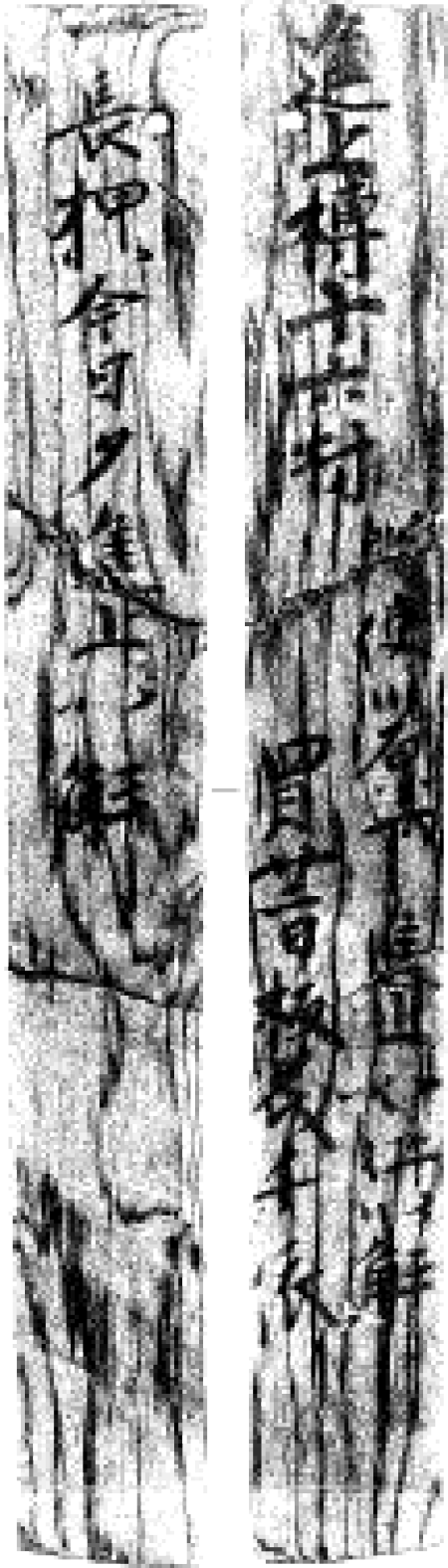
The notification of the shipment and receipt of an exposed tie beam indicates that in some cases, logs were processed and finished before they were transported to the construction site.
Image reproduced from Van Goethem, Nagaoka, p. 276.
This long and narrow wooden tablet was likely split in half before being discarded and most of the text is missing. Nevertheless, from what was preserved we can deduce that it was most likely sent by the East Great Palace Construction Office, an extraordinary office set up for the construction of Kanmu's East Palace, his second residence in the Nagaoka capital.
The date on the back of the tablet predates by forty days an entry in the Shoku Nihongi that announced the move of Kanmu from his first residence, the West Palace, to his second residence, the East Palace.
On the tablet, this palace is called East Great Palace (東大宮), possibly to avoid confusion with the crown prince’s Eastern Palace (東宮).
Image reproduced from Van Goethem, Nagaoka, p. 277.
Inscribed Wooden Tablets
Publications
歴史資料・資源としての木簡—長岡京の場合 [Wooden Tablets as Historical (Re)Sources: Case-Study of the Nagaoka Capital],’ in 交響する古代II国際的日本古代学の展開 [The Reverberating Past II: The Development of International Ancient Japanese Studies] (Research Institute for Ancient Japanese Studies, Meiji University, 2012), 35–40.
Nagaoka, Japan’s Forgotten Capital (Leiden: Brill Academic Publishers, 2008; 2010 e-book edition; 2022 Open Access edition).
‘The Construction of the Nagaoka Palace and Capital – Mokkan 木簡 as a Historical Source’, in Nachrichten der Gesellschaft für Natur- und Völkerkunde Ostasiens (NOAG) 76:179/180 (2006), 143–74.
Conference Presentations and Invited Lectures
September 23, 2025
“Inscribed Wooden Tablets: Between History and Archaeology”
University of Naples l’Orientale, Department of Asian, African, and Mediterranean Studies (DAAM)
October 4, 2023
“Mokkan Inscribed Wooden Tablets”
Meijō University
October 18, 2022
“Ancient Japan: Domestic and International Research”
Meijō University
November 15, 2013
“Written, Used, Discarded, and Unintentionally Preserved: Writings on Wood in Ancient Japan”
CSMC Conference on “Manuscripts and Epigraphy,” Hamburg University, Centre for the Study of Manuscript Cultures
March 20, 2012
歴史資料・資源としての木簡―長岡京の場合 [Wooden Tablets as Historical (Re)Sources: Case-Study of the Nagaoka Capital]
国際学術研究会 『国際的日本古代学の展開—交響する古代II』[International Conference The Development of International Ancient Japanese Studies: The Reverberating Past II], Meiji
University Institute for the Ancient Studies of Japan
September 25, 2007
“The Nagaoka Capital (784-794 AD) and Inscribed Wooden Tablets”
Kyoto Asian Studies Group, Kyoto University
June 15, 2007
“The Nagaoka capital and its mokkan (inscribed wooden tablets)”
Leiden University
November 17, 2005
“De mokkan van Nagaokakyō, hun belang voor wetenschappelijk onderzoek” [The scholarly significance of the mokkan unearthed from the former Nagaoka Capital]
Ghent University
March 2, 2005
“The wooden tablets (mokkan) of Nagaokakyō”
University of Bucharest
Funding
This research is funded by
Japanese Government (Monbukagakusho) Scholarship, Kyoto University (2003–2004)
Europalia Nippon Kinen research grant, Mie University, the Center for Buried Cultural Properties (Mukō city), and the Nara National Research Institute for Cultural Properties (2001)