Reiterations of the Past: Reconstructions, Practices, and Places
I spearheaded Reiterations of the Past, a three-year project designed to foster international collaboration and generously funded by Kyushu University’s Progress 100 Strategic Partnership Acceleration Program (世界トップレベル研究者招へいプログラム「Progress 100」戦略的パートナーシップ構築型). While originally intended as a residency program for scholars affiliated with top-100 universities to engage in collaborative on-site research and teaching for periods of up to one month, the project necessarily pivoted in response to the global pandemic after its first year. The project’s resources were redirected to launch an extensive online program consisting of more than 60 public lectures and 5 graduate-level courses that were attended by colleagues and students worldwide.
2019–2020
During the first year, I facilitated residencies of up to one month for eight visiting scholars. The residencies centered on collaborative research and teaching and were highlighted by three public lectures that extended the project’s reach to a broader audience:
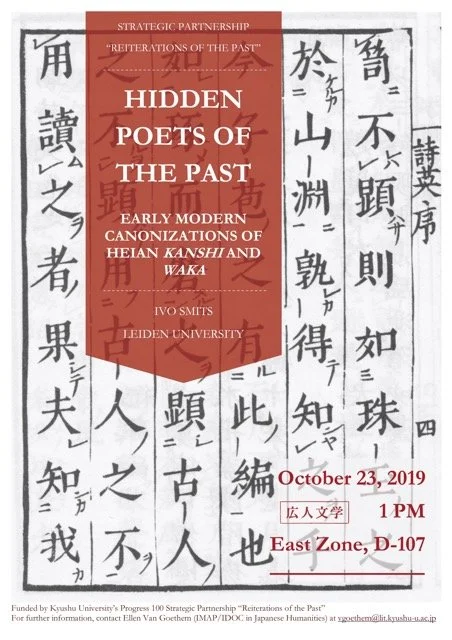
Ivo Smits, “Hidden Poets of the Past: Early Modern Canonizations of Heian Kanshi and Waka”
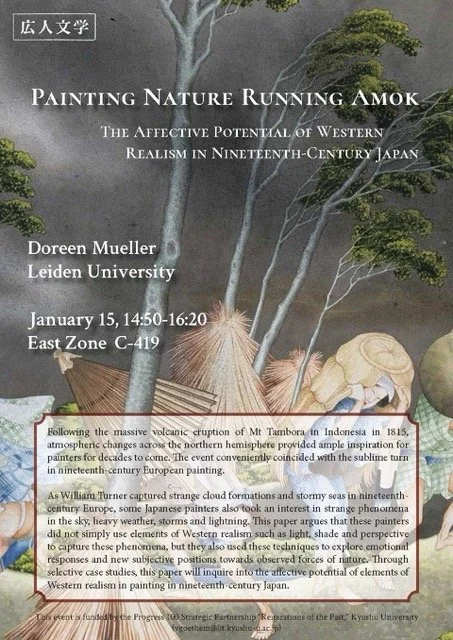
Doreen Mueller, “Painting Nature Running Amok: The Affective Potential of Western Realism in Nineteenth-Century Japan”
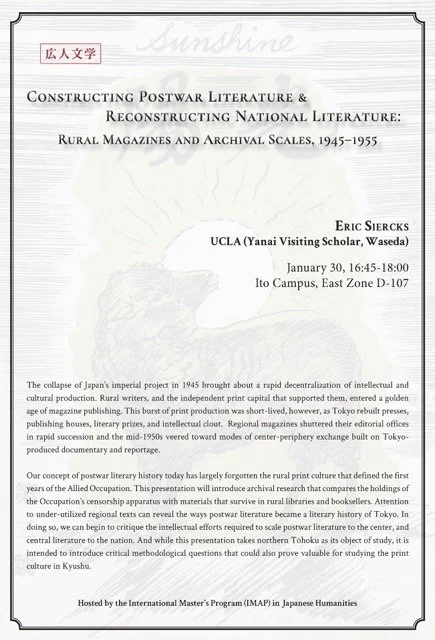
Eric Siercks, “Constructing Postwar Literature/Reconstructing National Literature: Rural Magazines and Archival Scales, 1945–1955” (co-organized with Caleb Carter)
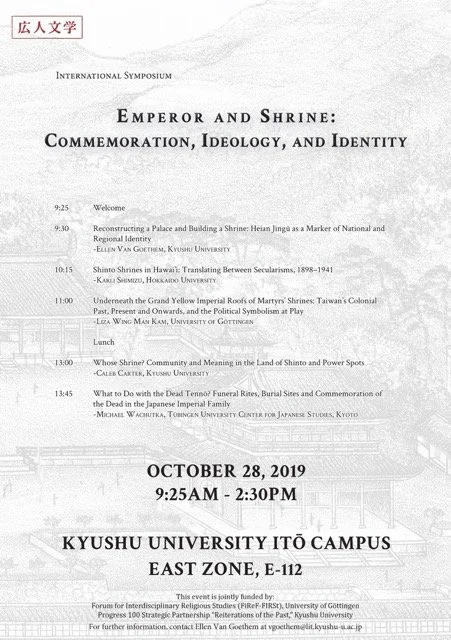
With visiting scholar Liza Wing Man Kam, I also organized an international symposium titled Emperor and Shrine: Commemoration, Ideology, and Identity (co-sponsored by the Forum for Interdisciplinary Religious Studies (FiReF-FIRSt), University of Göttingen)
Ellen Van Goethem, Kyushu University
“Reconstructing a Palace and Building a Shrine: Heian Jingū as a Marker of National and Regional Identity”
Karli Shimizu, Hokkaido University
“Shinto Shrines in Hawai’i: Translating Between Secularisms, 1898–1941”
Liza Wing Man Kam, University of Göttingen
“Underneath the Grand Yellow Imperial Roofs of Martyrs’ Shrines: Taiwan’s Colonial Past, Present and Onwards, and the Political Symbolism at Play”
Caleb Carter, Kyushu University
“Whose Shrine? Community and Meaning in the Land of Shinto and Power Spots”
Michael Wachutka, Tübingen University Center for Japanese Studies, Kyoto
“What to Do with the Dead Tennō? Funeral Rites, Burial Sites and Commemoration of the Dead in the Japanese Imperial Family”
2020–2021
In collaboration with Caleb Carter, I organized a series of seven online lectures that explored diverse facets of cultural history, ritual, and gender. The series brought together international specialists to present new research on topics ranging from medieval legends and samurai social history to modern Shinto priesthood and architectural design:
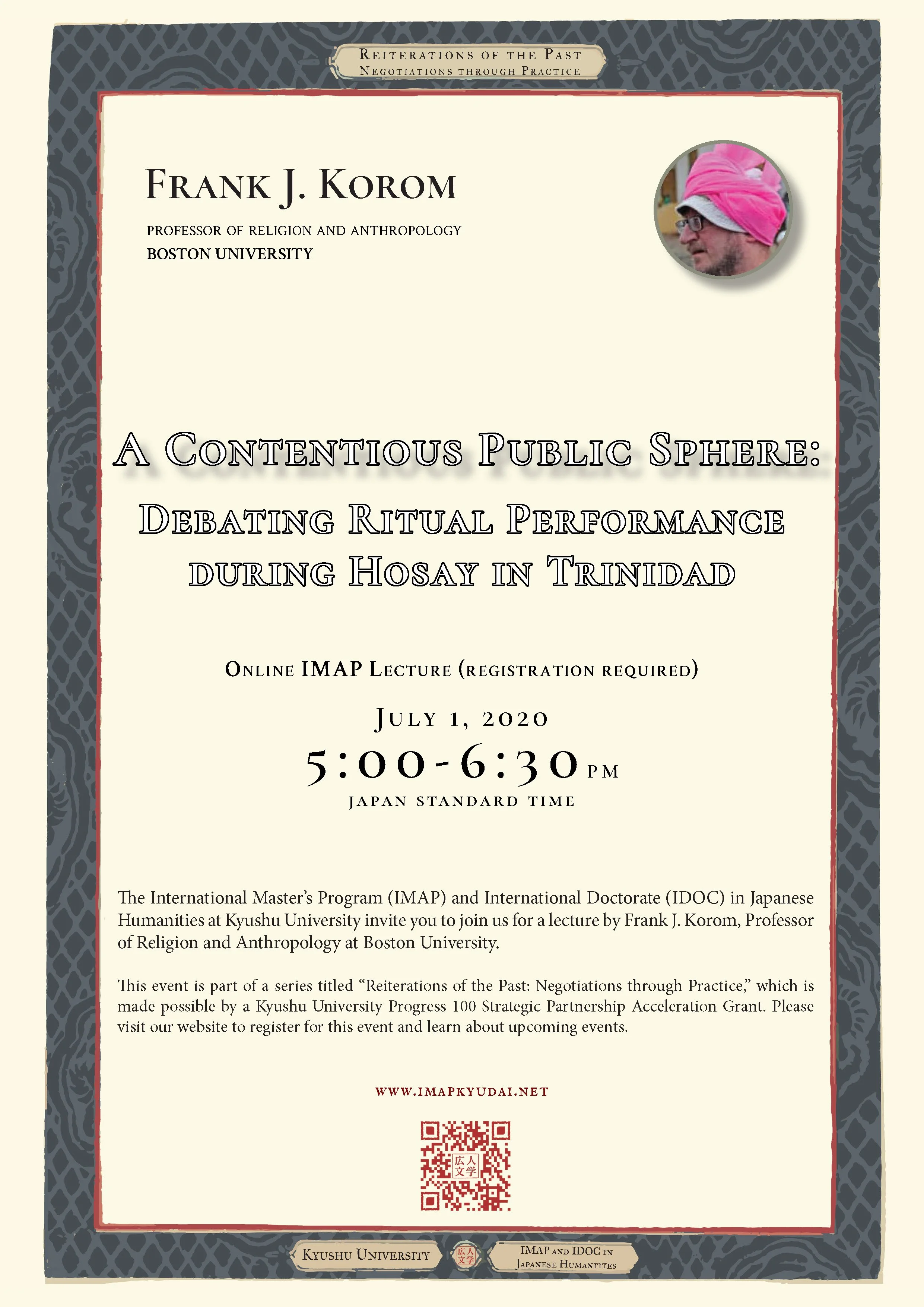
Frank Korom, “A Contentious Public Sphere: Debating Ritual Performance during Hosay in Trinidad”
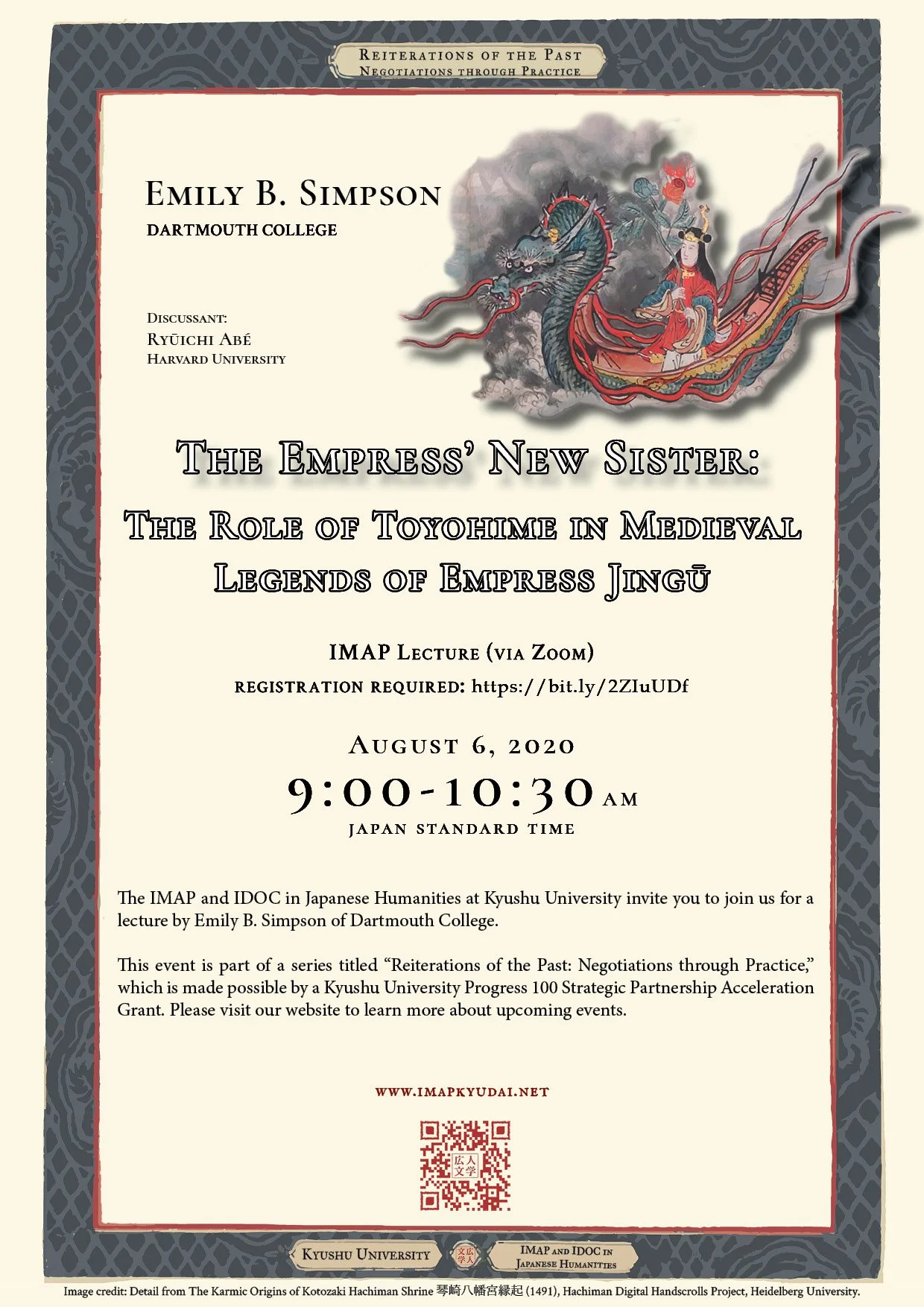
Emily B. Simpson and Ryūichi Abé, “The Empress’s New Sister: The Role of Toyohime in Medieval Legends of Empress Jingū”
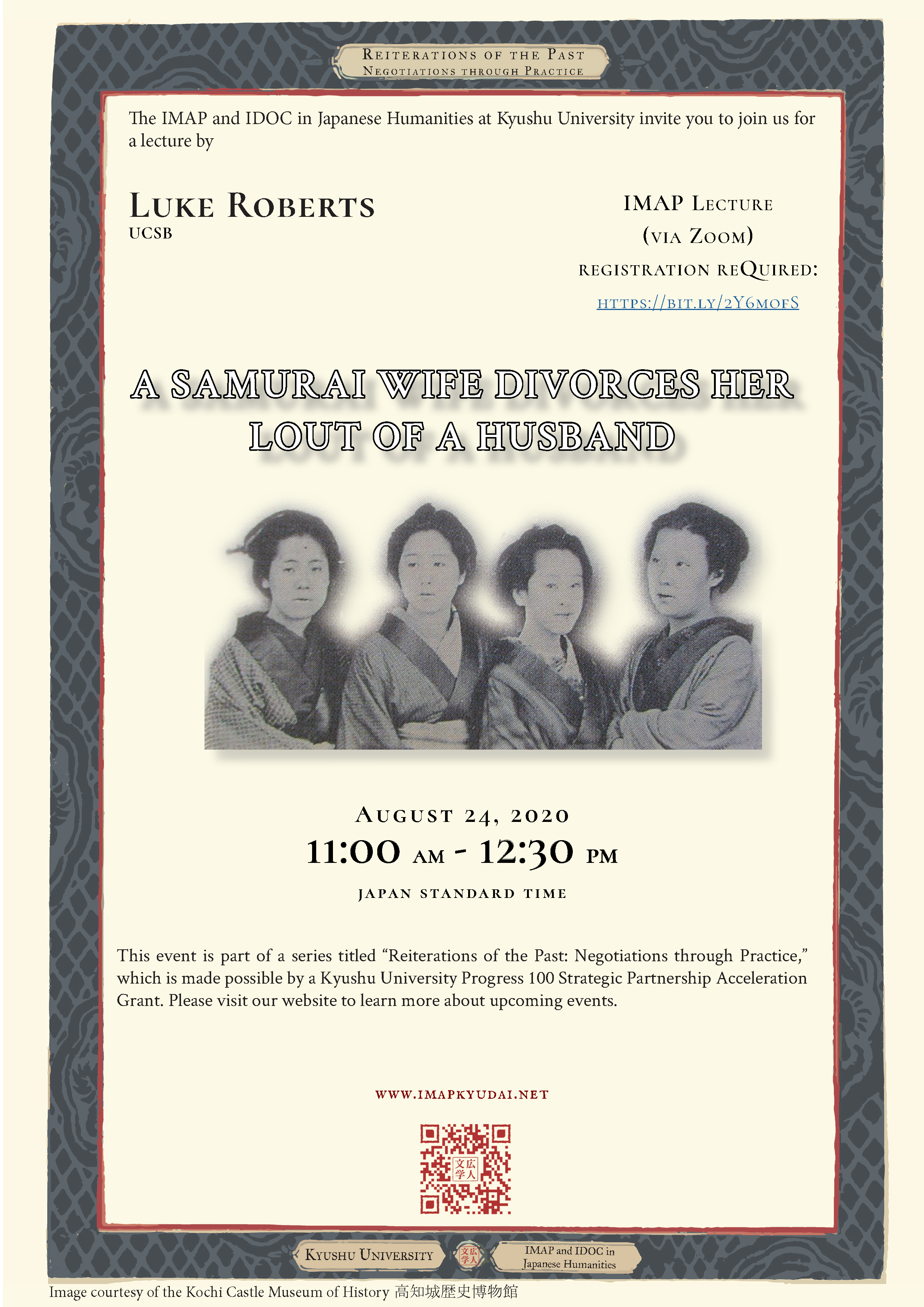
Luke Roberts, “A Samurai Wife Divorces Her Lout of a Husband”
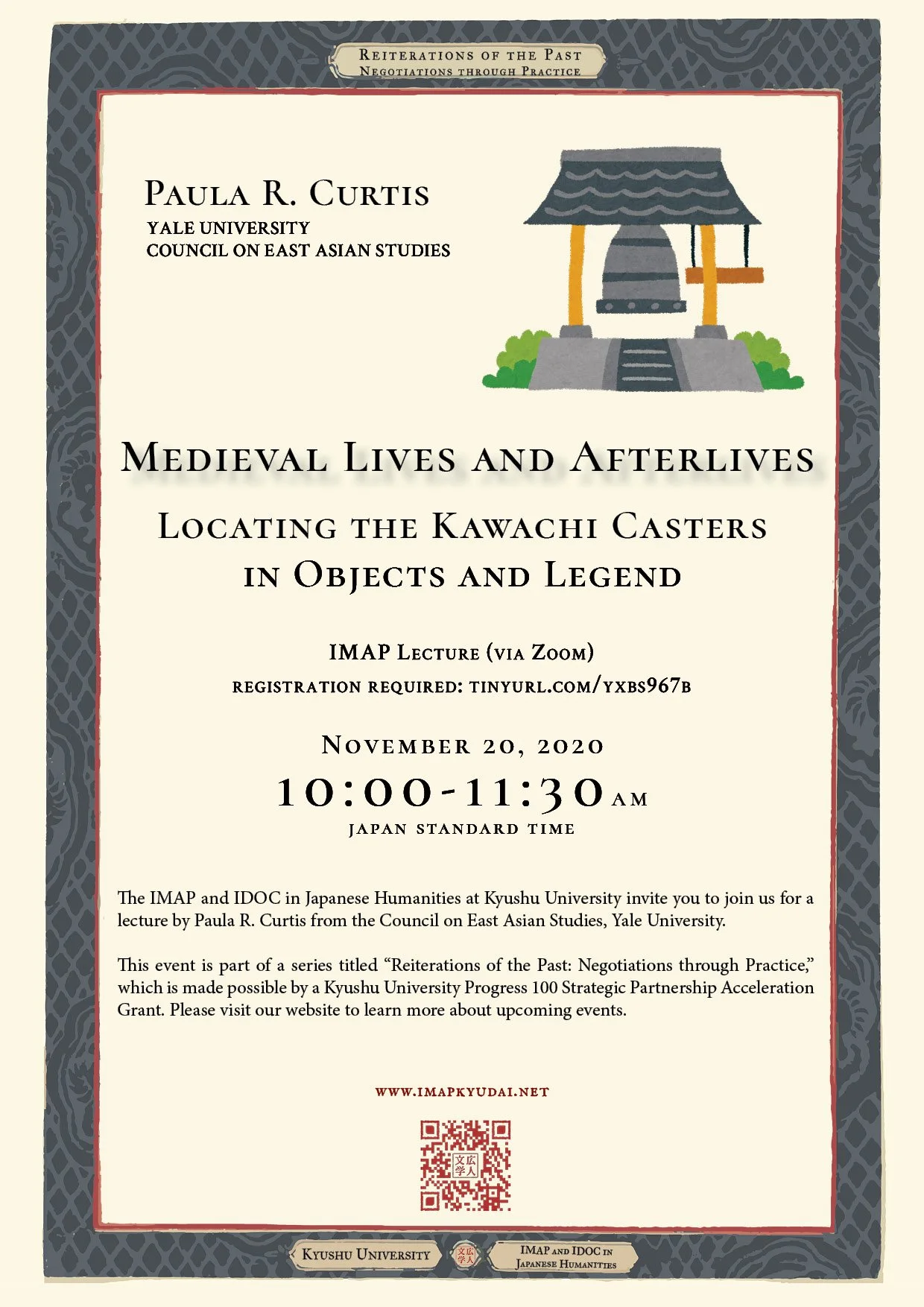
Paula Curtis, “Medieval Lives and Afterlives: Locating the Kawachi Casters in Objects and Legend”
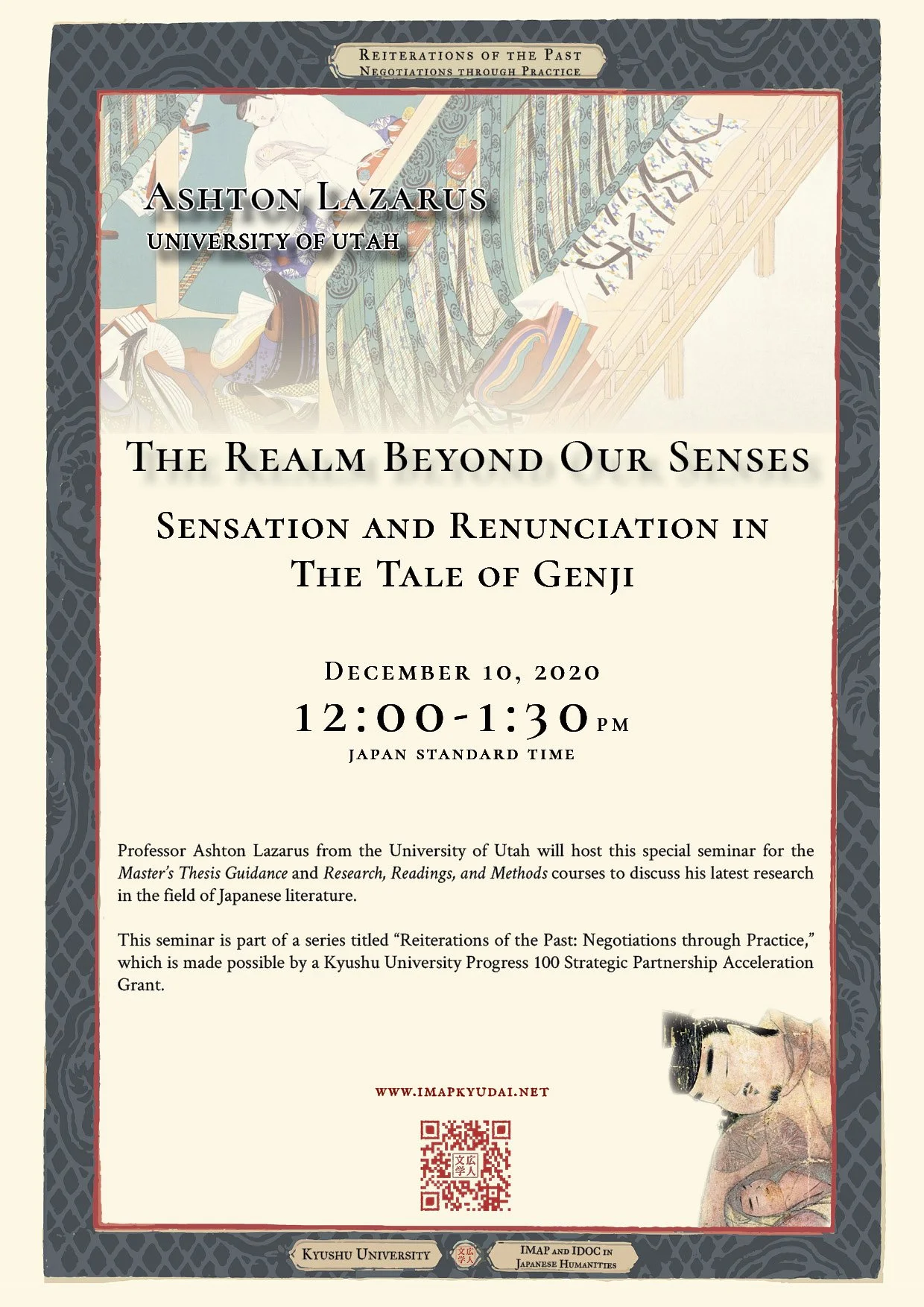
Ashton Lazarus, “‘The Realm Beyond Our Senses’: Sensation and Renunciation in The Tale of Genji”
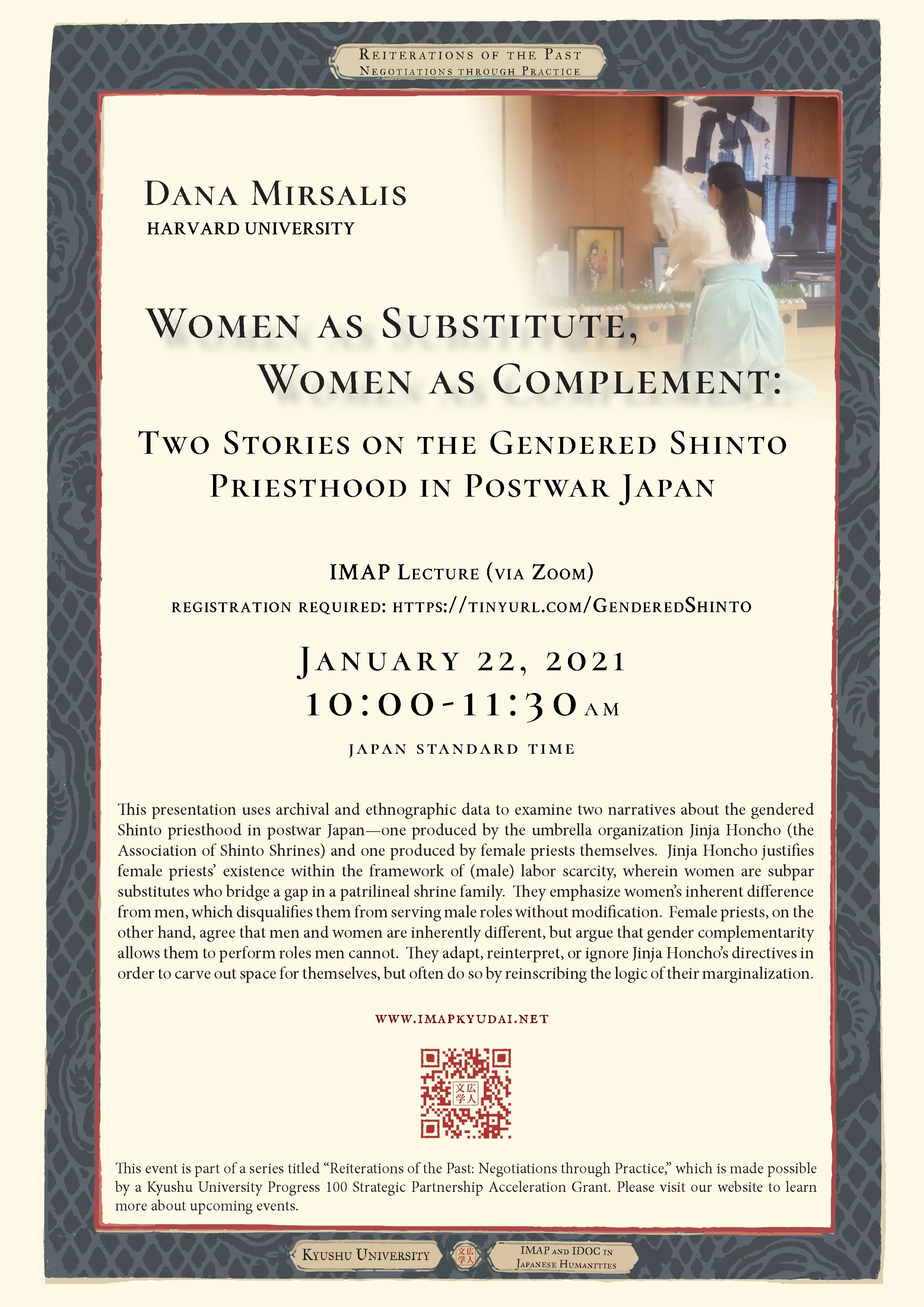
Dana Mirsalis, “Women as Substitute, Women as Complement: Two Stories on the Gendered Shinto Priesthood in Postwar Japan”
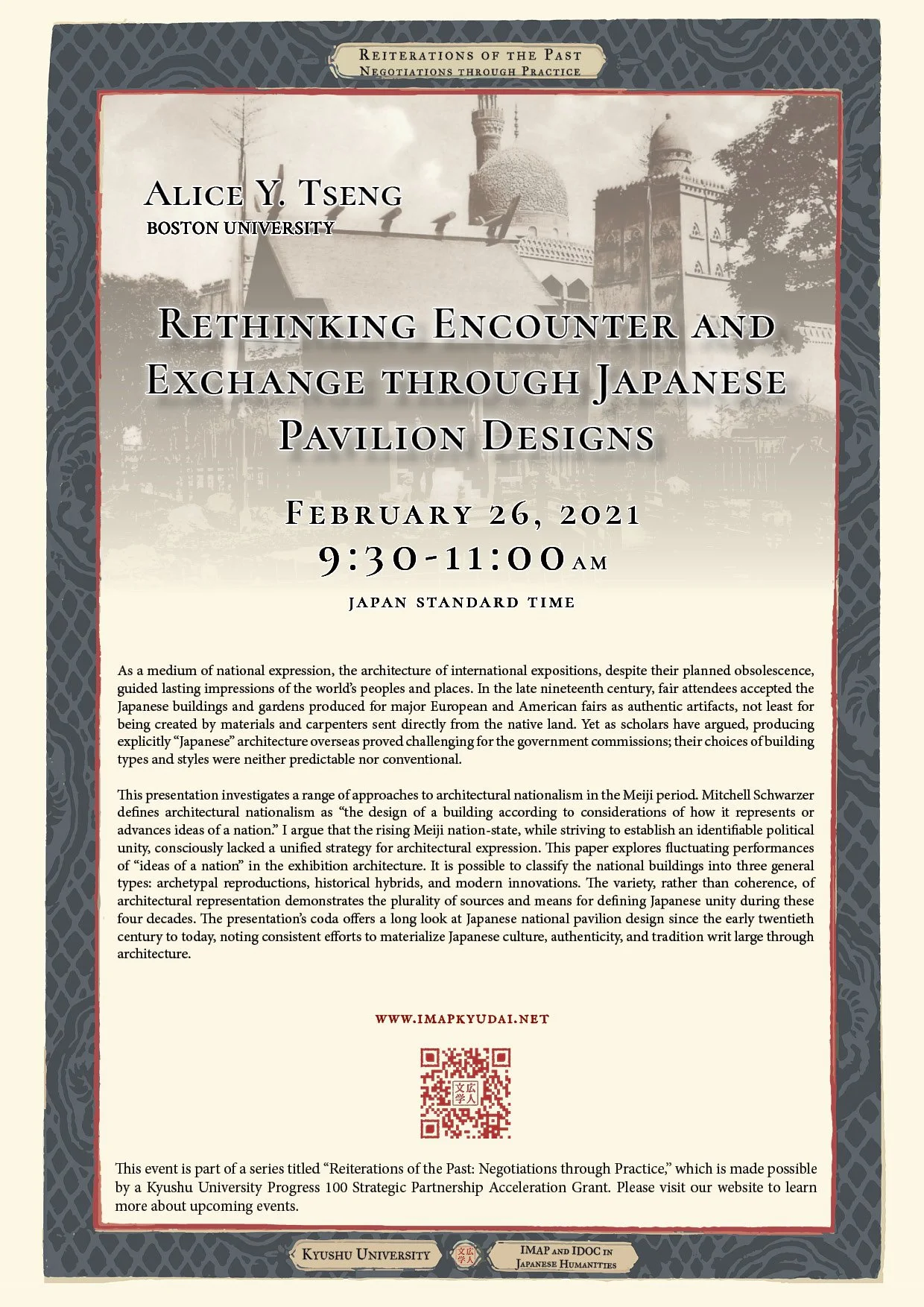
Alice Tseng, “Rethinking Encounter and Exchange through Japanese Pavilion Designs”
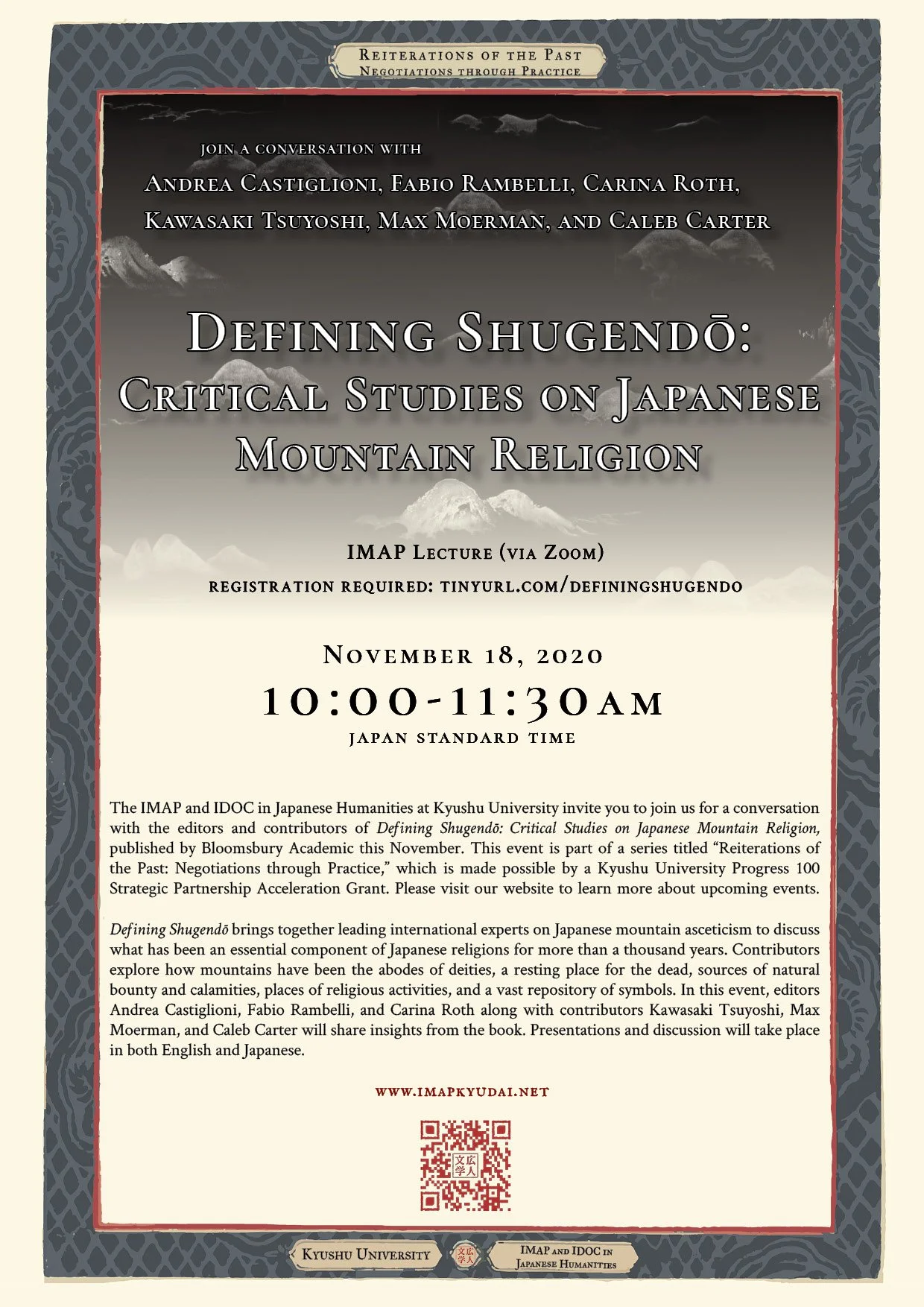
To commemorate the publication of Defining Shugendō: Critical Studies on Japanese Mountain Religions (Bloomsbury, 2020), we also held an online book launch event. Alongside the volume's editors—Andrea Castiglioni, Fabio Rambelli, and Carina Roth—the event featured contributions from Max Moerman, Tsuyoshi Kawasaki, and Caleb Carter to present their insights from the volume and to discuss the volume's impact on the study of Japanese mountain religions.
2021–2022
The project’s online lecture series reached its full momentum in the third year. I coordinated a comprehensive curriculum of more than 50 lectures delivered by scholars from institutions across North America, Europe, Africa, and Asia. The lectures were structured around five core graduate-level courses:
“Historians at Work”
“Archaeology and Heritage”
“Japanese Religious Studies Behind the Scenes” (co-organized with Caleb Carter)
“The Idea and Praxis of Medievalism: Castles, Samurai, and Mongols in Modern Japan” (co-organized with Ran Zwigenberg)
“Religion in Manga, Anime and Popular Media” (co-organized with Emily B. Simpson and Caleb Carter)
Historians at Work
I developed the 'Historians at Work' series to provide students and colleagues with a behind-the-scenes look at the work of a historian through the lens of Japanese studies. My goal was to move beyond finished research and highlight the mechanics of the field. With 17 lectures ranging from the decipherment of medieval manuscripts and the use of geospatial analysis to the navigation of digital archives and the complexities of professionalization, I intended to bridge the gap between archival data and historical narrative.
Each guest speaker was asked to deliver a pair of lectures. While the first served as a standard presentation of their latest work, I requested the second to be geared toward the craft of history. In these sessions, scholars engaged in transparent discussions about their working methods, providing first-hand insights into how research projects are conceptualized and executed.
Thomas Conlan, “Designing and Disseminating Digital Sources for Medieval Japan”
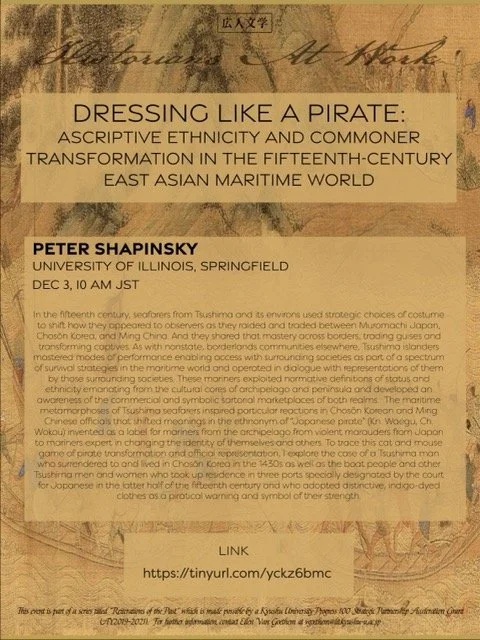
Peter Shapinsky, “Dressing Like a Pirate: Ascriptive Ethnicity and Commoner Transformation in the Fifteenth-Century East Asian Maritime World”
Peter Shapinsky and Morten Oxenboell, “A Postcolonial Approach to Medieval Studies”
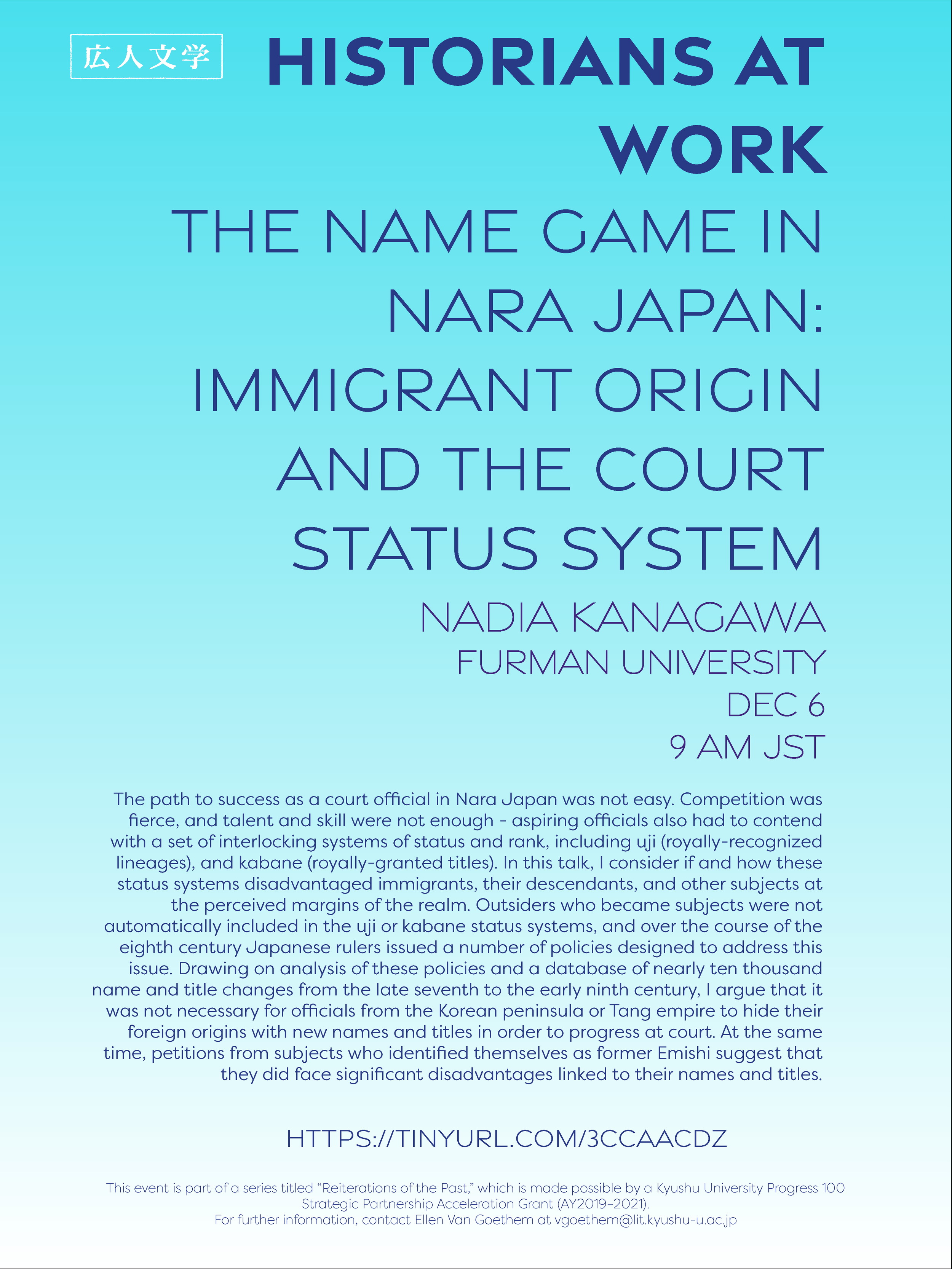
Nadia Kanagawa, “The Name Game in Nara Japan: Immigrant Origin and the Court Status System”
Nadia Kanagawa and Paula Curtis, “Thinking Through Difficult Documents: Methods & Technology”
Nadia Kanagawa and Paula Curtis, “Ask Us Anything: Professionalization, Research, Job Prep & Beyond”
Morten Oxenboell, “Vanishing Woodlands: Environment and Conflict in Thirteenth-Century Japan”
Travis Seifman, “Introduction to the Ishin Shiryō Koyo Database: A Chronology of Events Leading up to the Meiji Revolution”
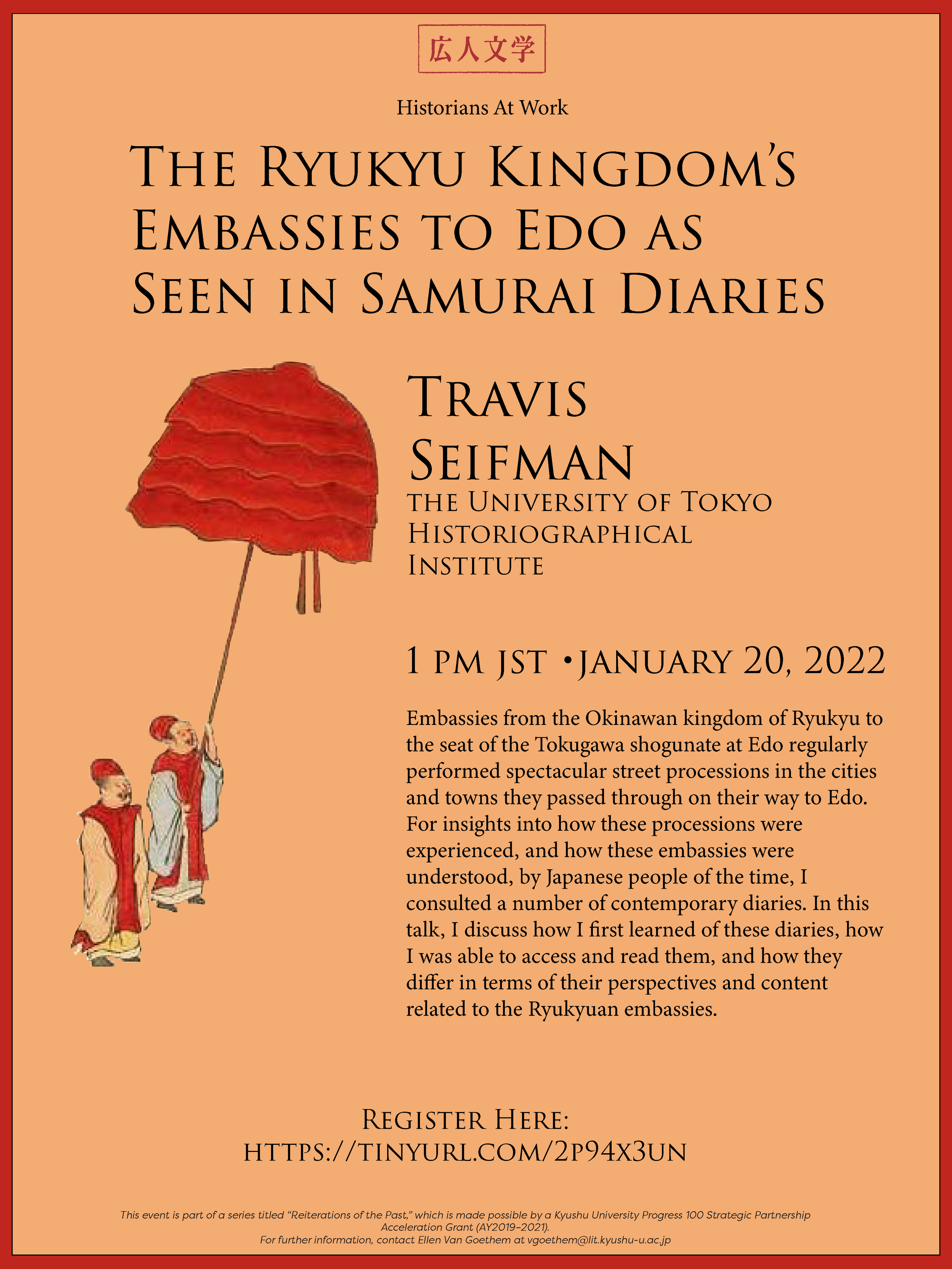
Travis Seifman, “The Ryukyu Kingdom’s Embassies to Edo as Seen in Samurai Diaries”
Marjorie Burge, “Mokkan: Wooden Fragments of Early History”
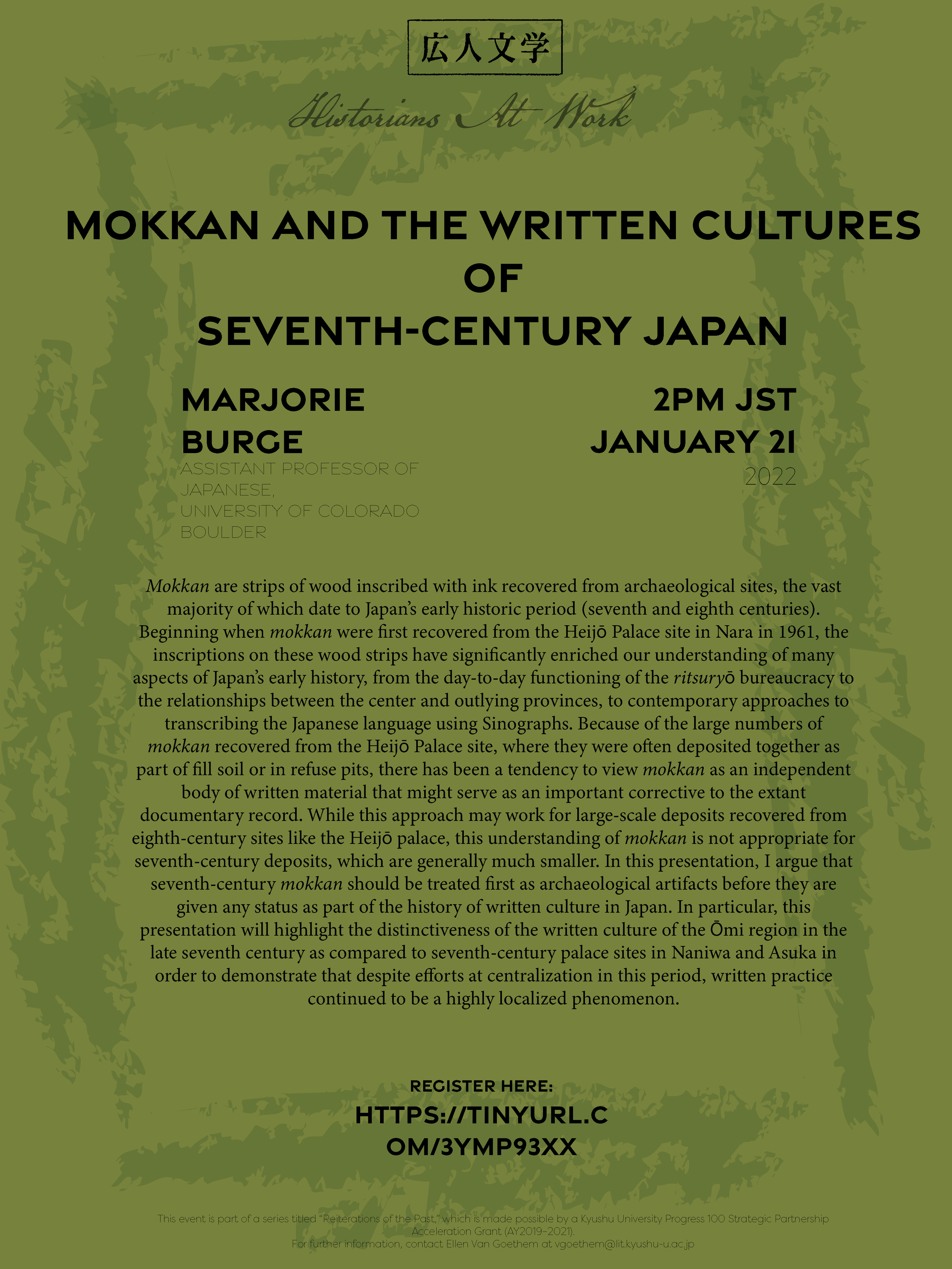
Marjorie Burge, “Mokkan and the Written Cultures of Seventh-Century Japan”
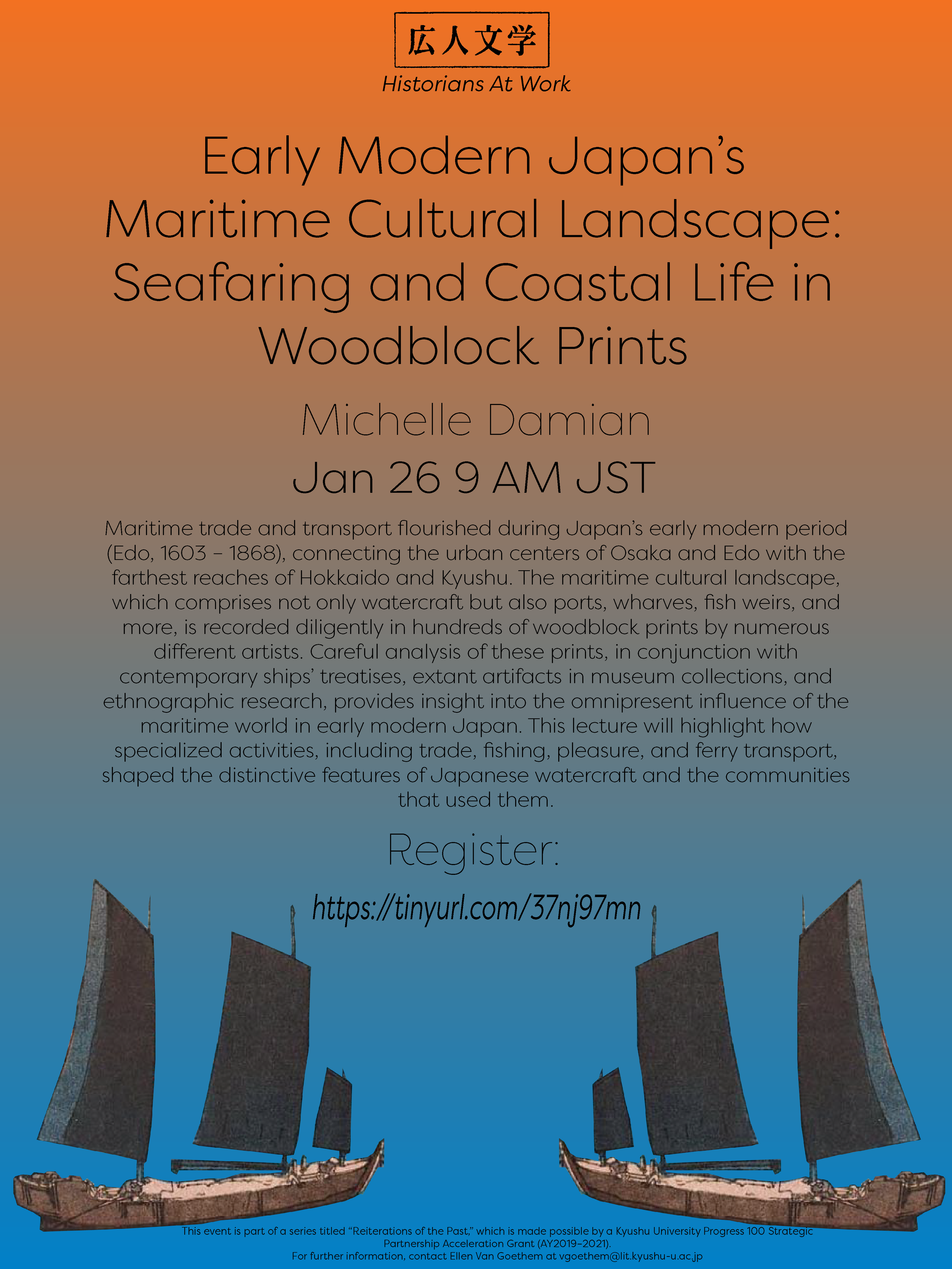
Michelle Damian, “Early Modern Japan’s Maritime Cultural Landscape: Seafaring and Coastal Life in Woodblock Prints”
Michelle Damian, “Geospatial Analysis: One Key to Unlocking the Hidden Histories of Medieval Maritime Japan”
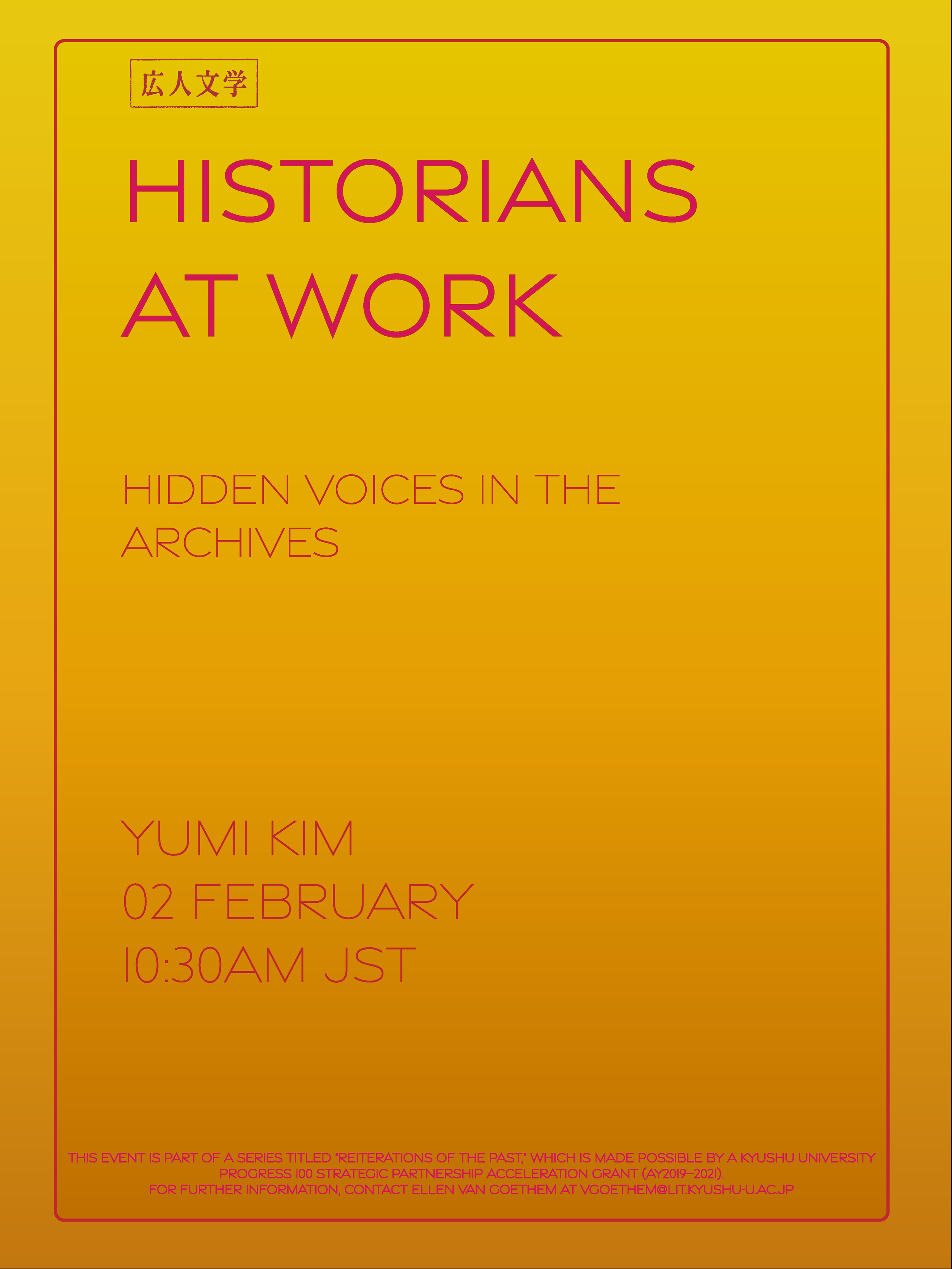
Yumi Kim, “Hidden Voices in the Archives”
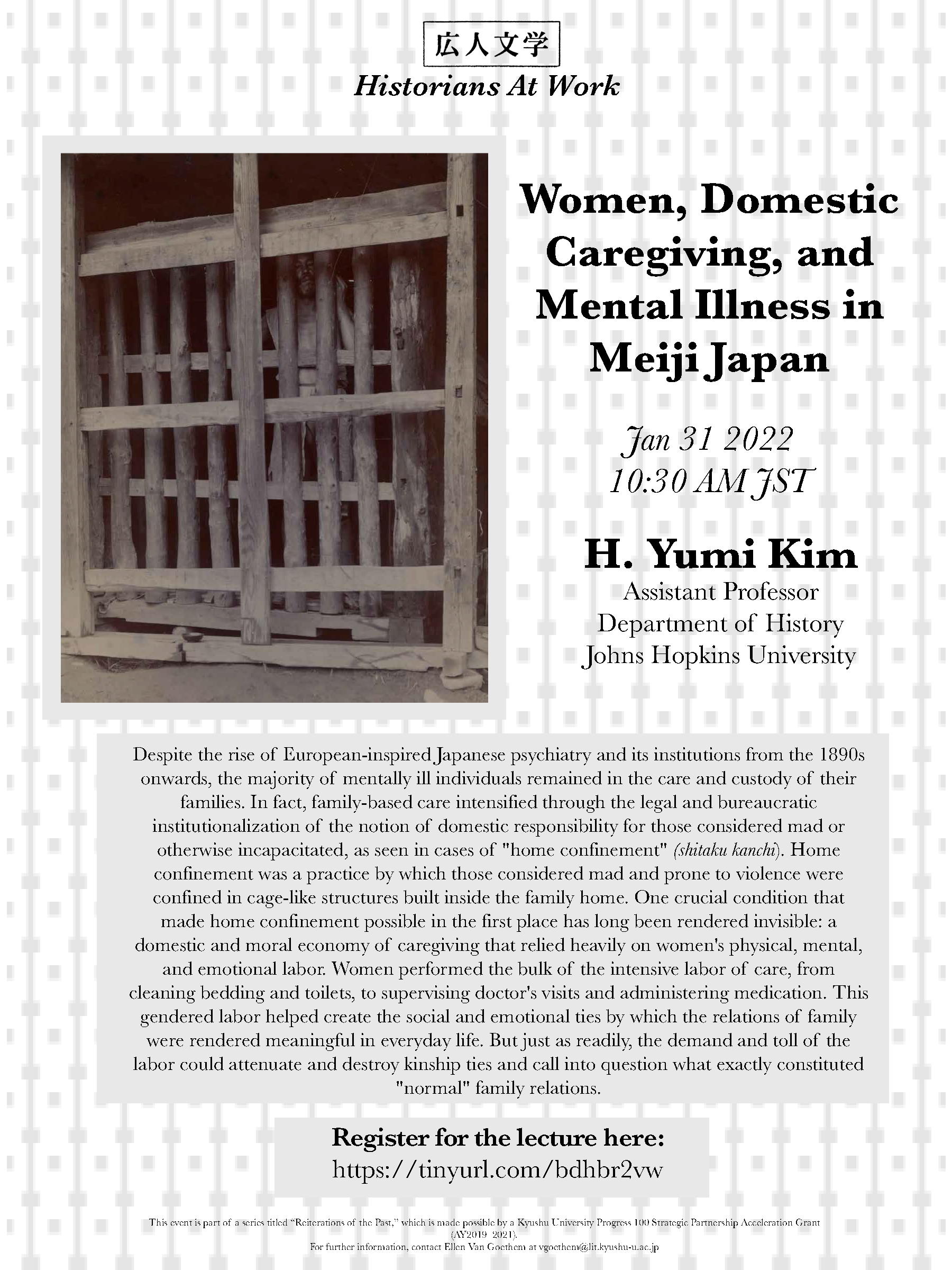
Yumi Kim, “Women, Domestic Caregiving, and Mental Illness in Meiji Japan”
Or Porath, “Doing Archival Research in Japan: Personal Reflections on Obtaining and Deciphering Manuscripts”
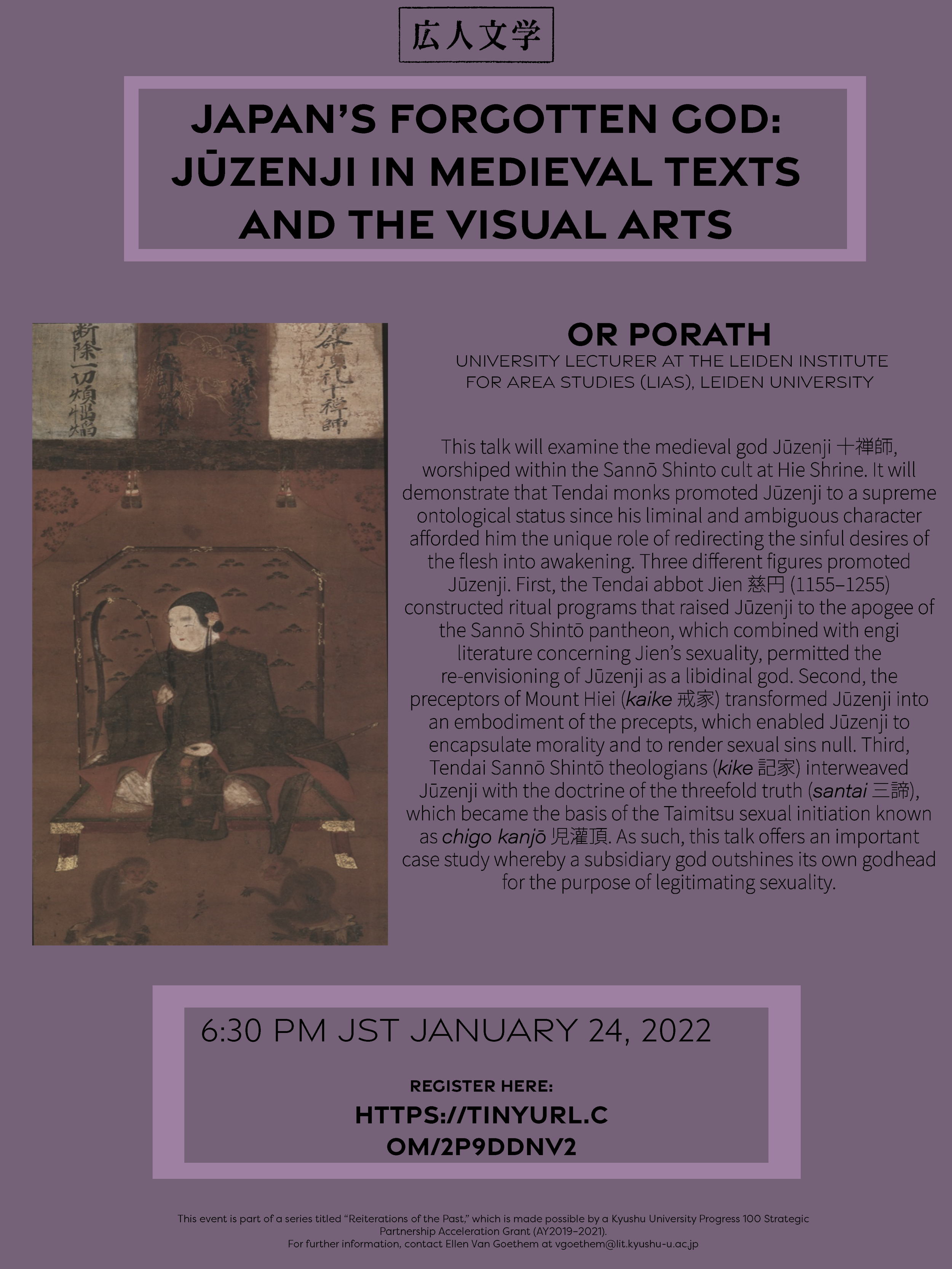
Or Porath, “Japan’s Forgotten God: Jūzenji in Medieval Texts and the Visual Arts”

Archaeology and Heritage
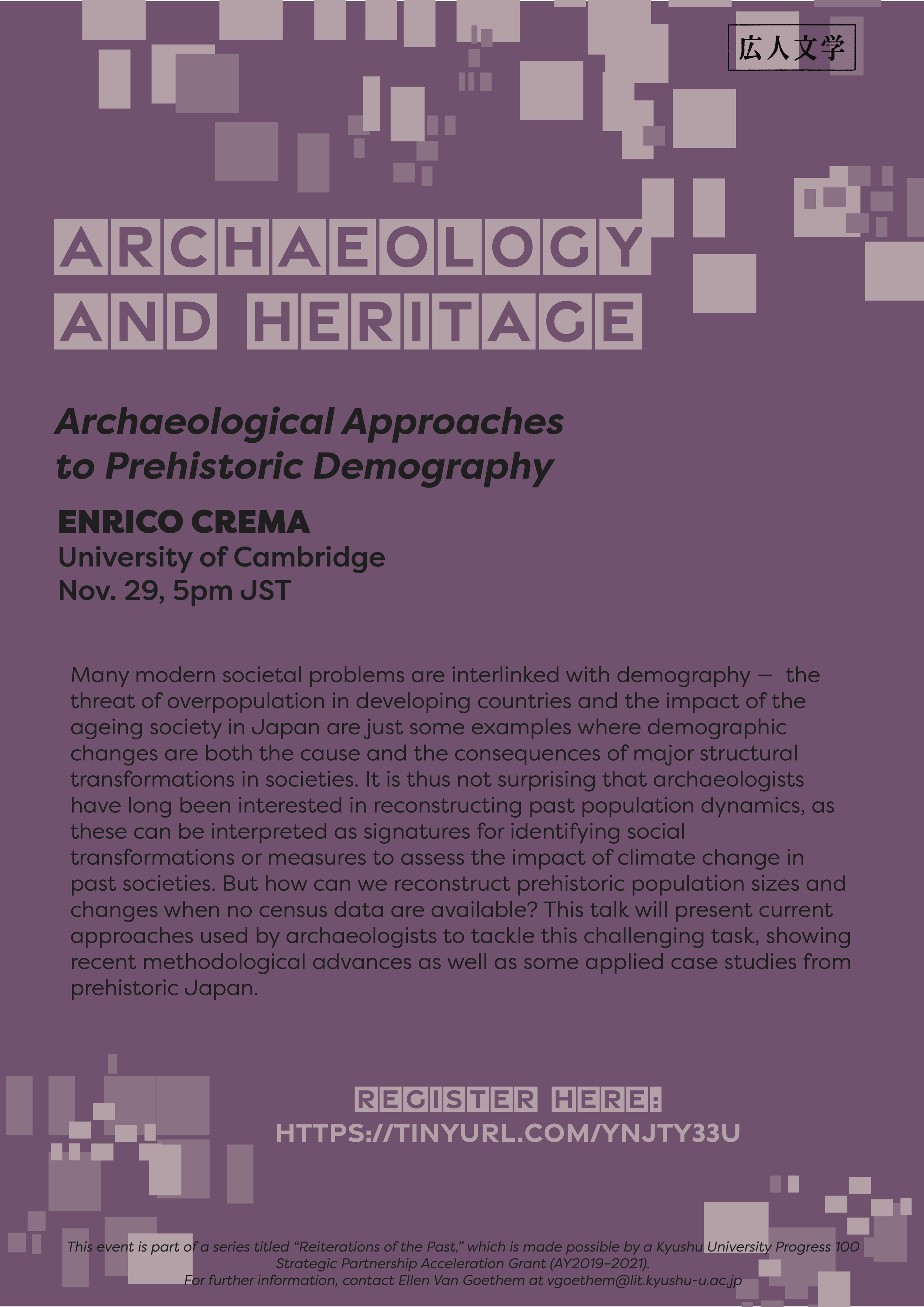
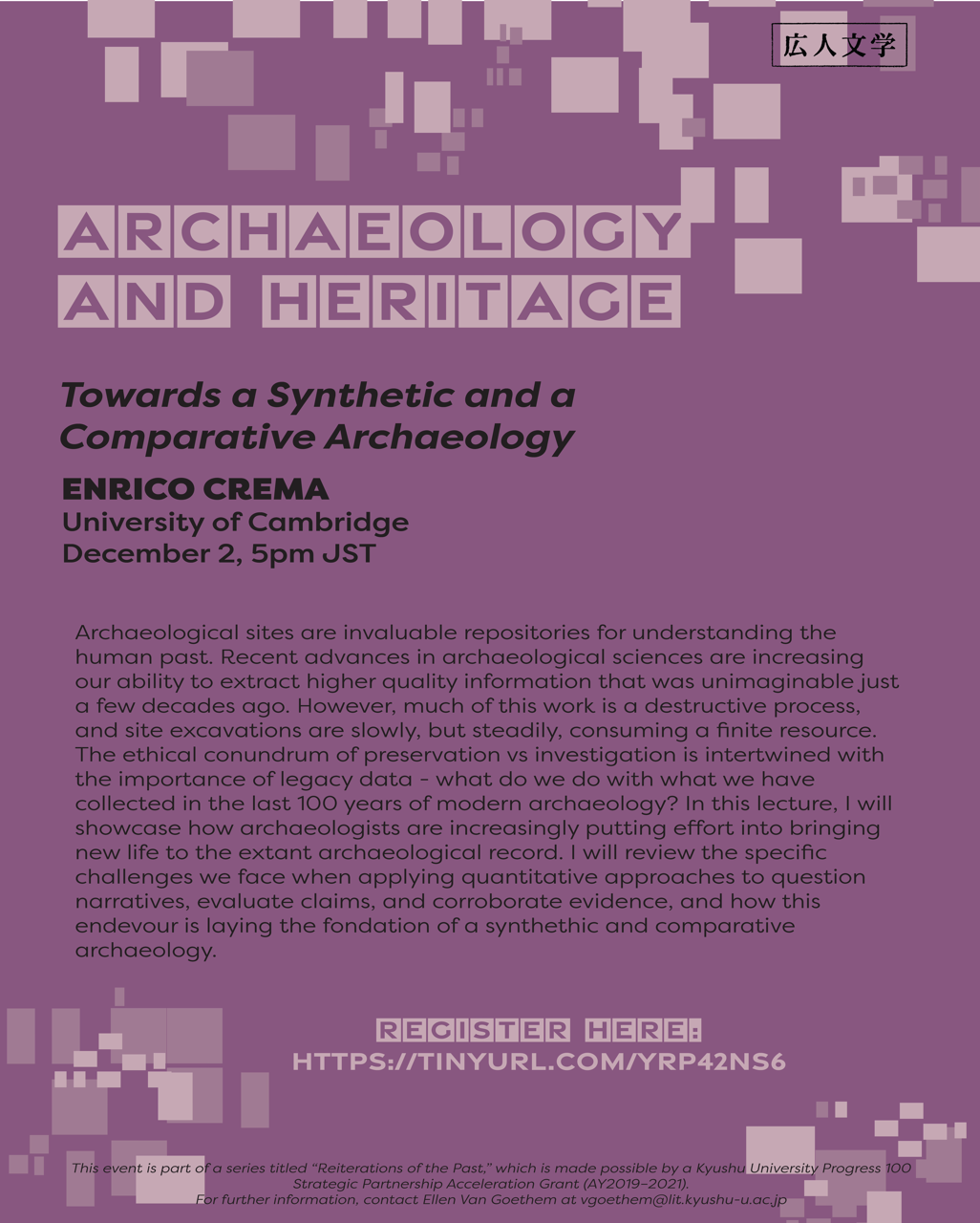
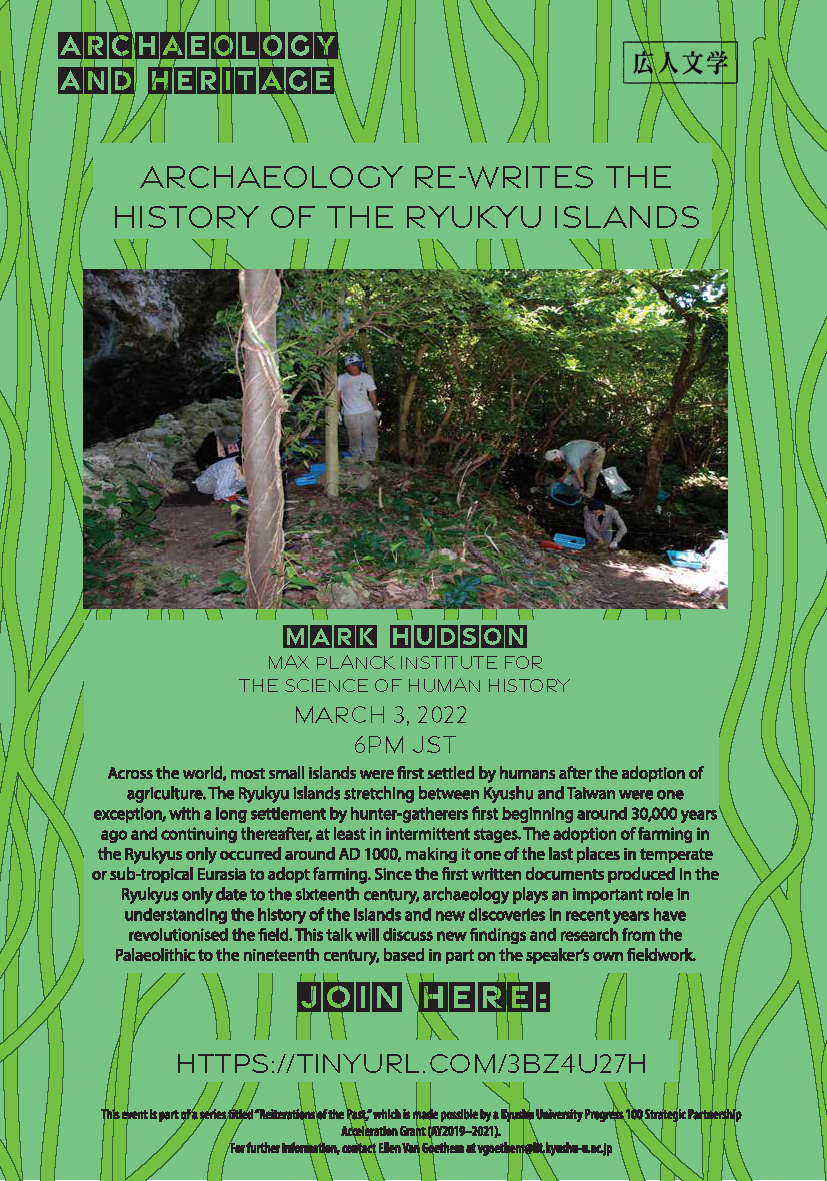
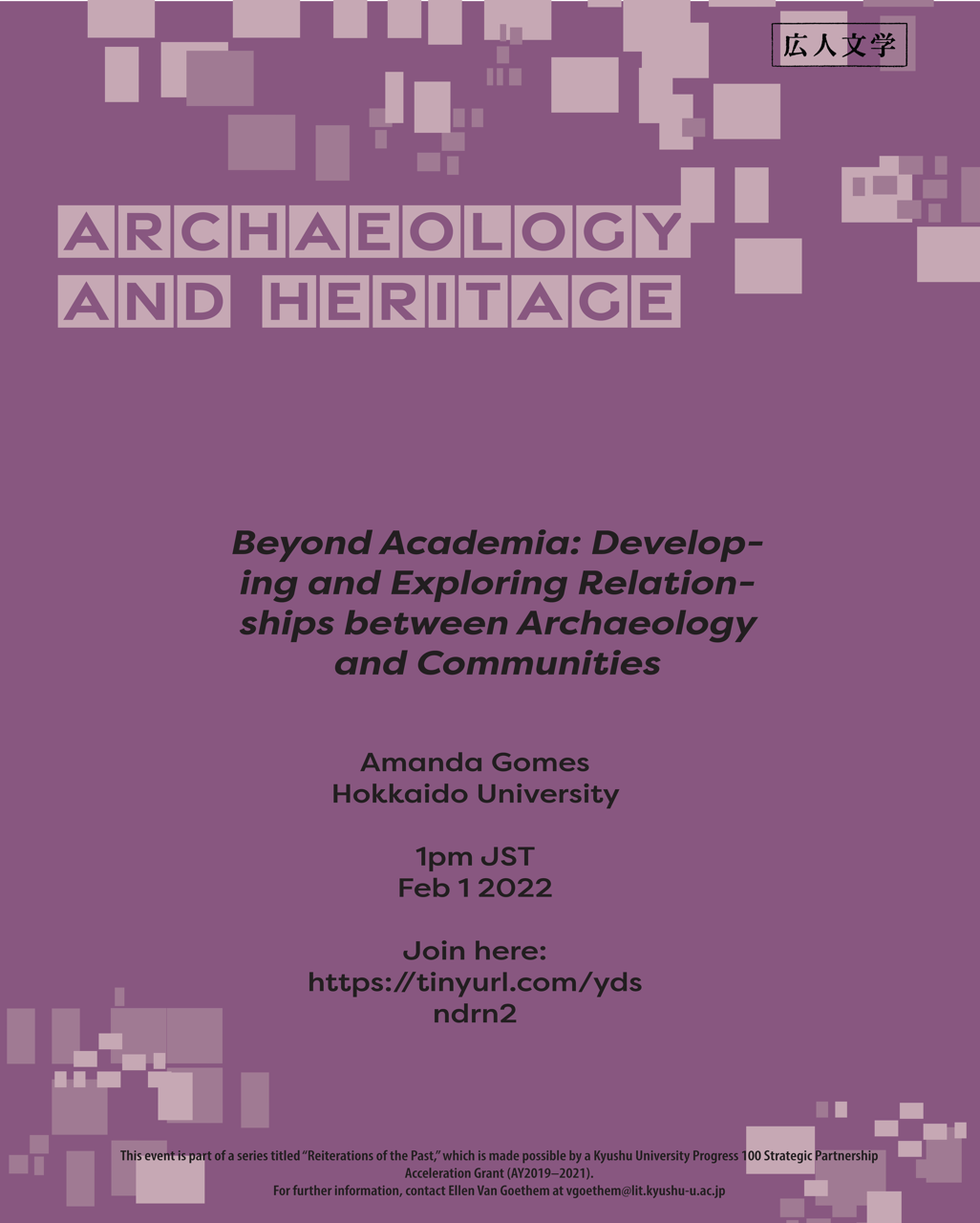
I curated the 10 lectures of the 'Archaeology and Heritage' series to provide a global perspective on material culture and its contemporary social relevance. While rooted in Japanese studies, I intentionally expanded the series' scope beyond the archipelago to include comparative insights from Maya archaeology. Moreover, I directed the series to explore the 'living' aspect of archaeology, specifically examining its impact on public heritage, community relationships, and individual wellbeing.
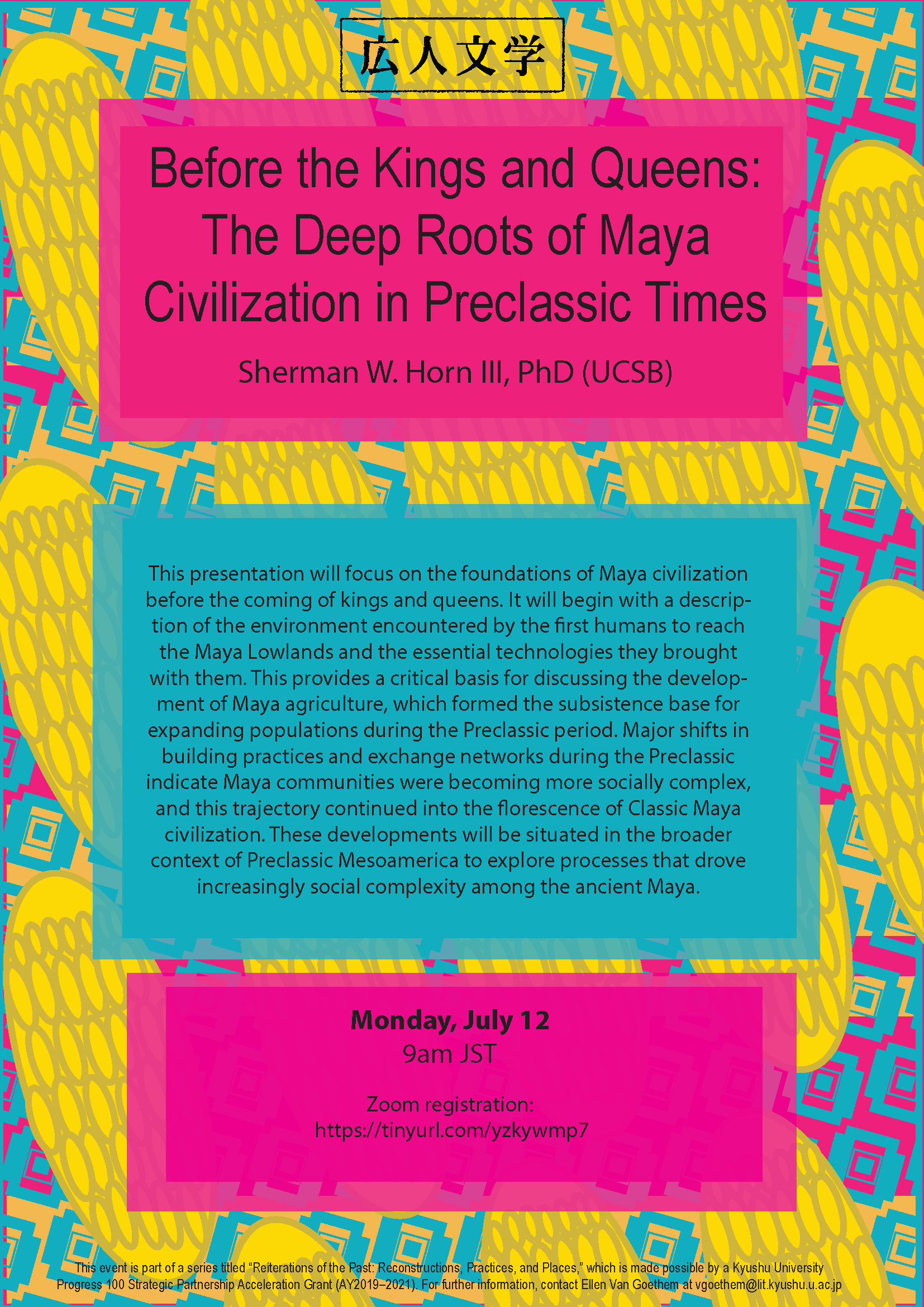
Sherman W. Horn, “Before the Kings and Queens: The Deep Roots of Maya Civilization in Preclassic Times”
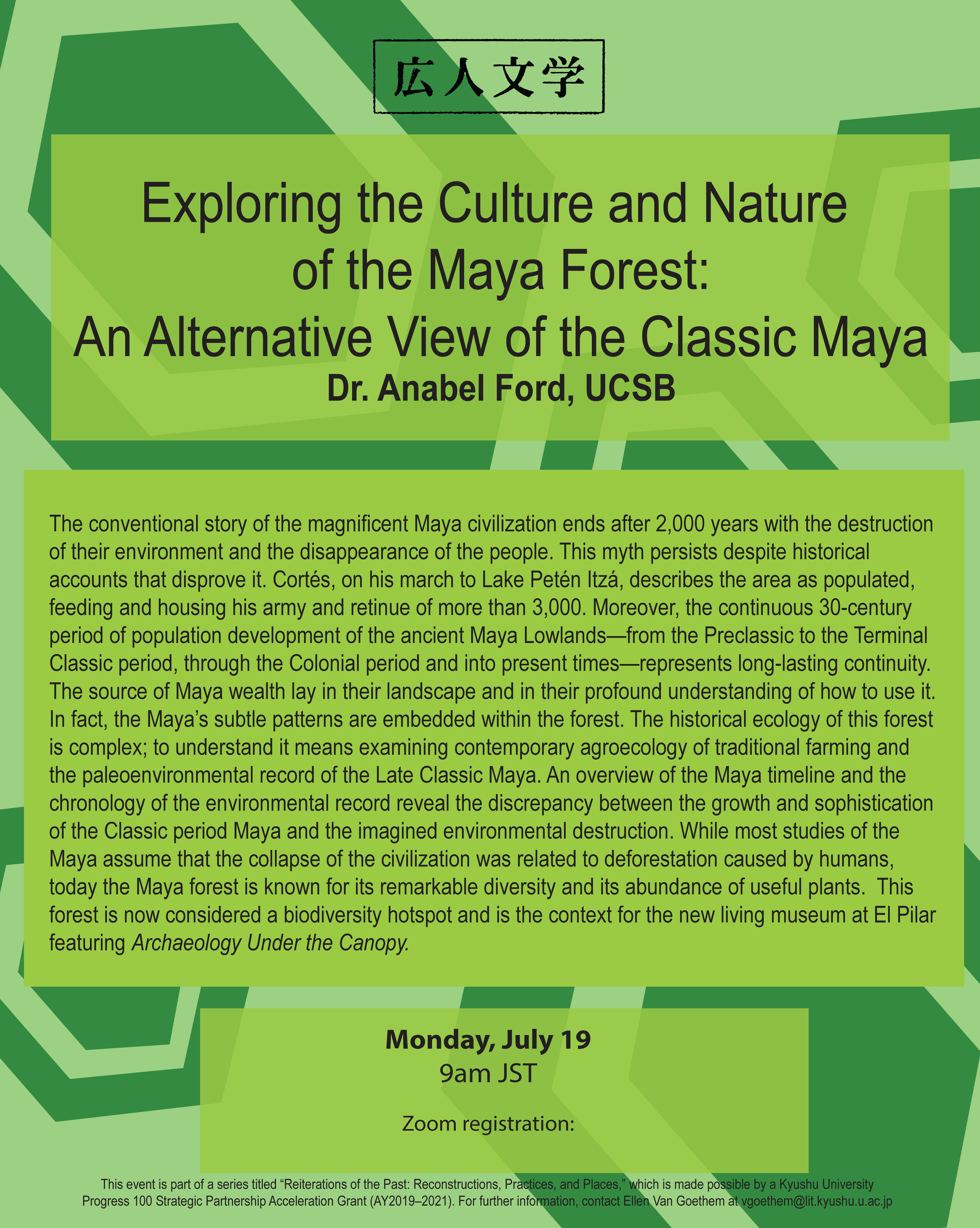
Anabel Ford, “Exploring the Culture and Nature of the Maya Forest: An Alternative View of the Classic Maya”
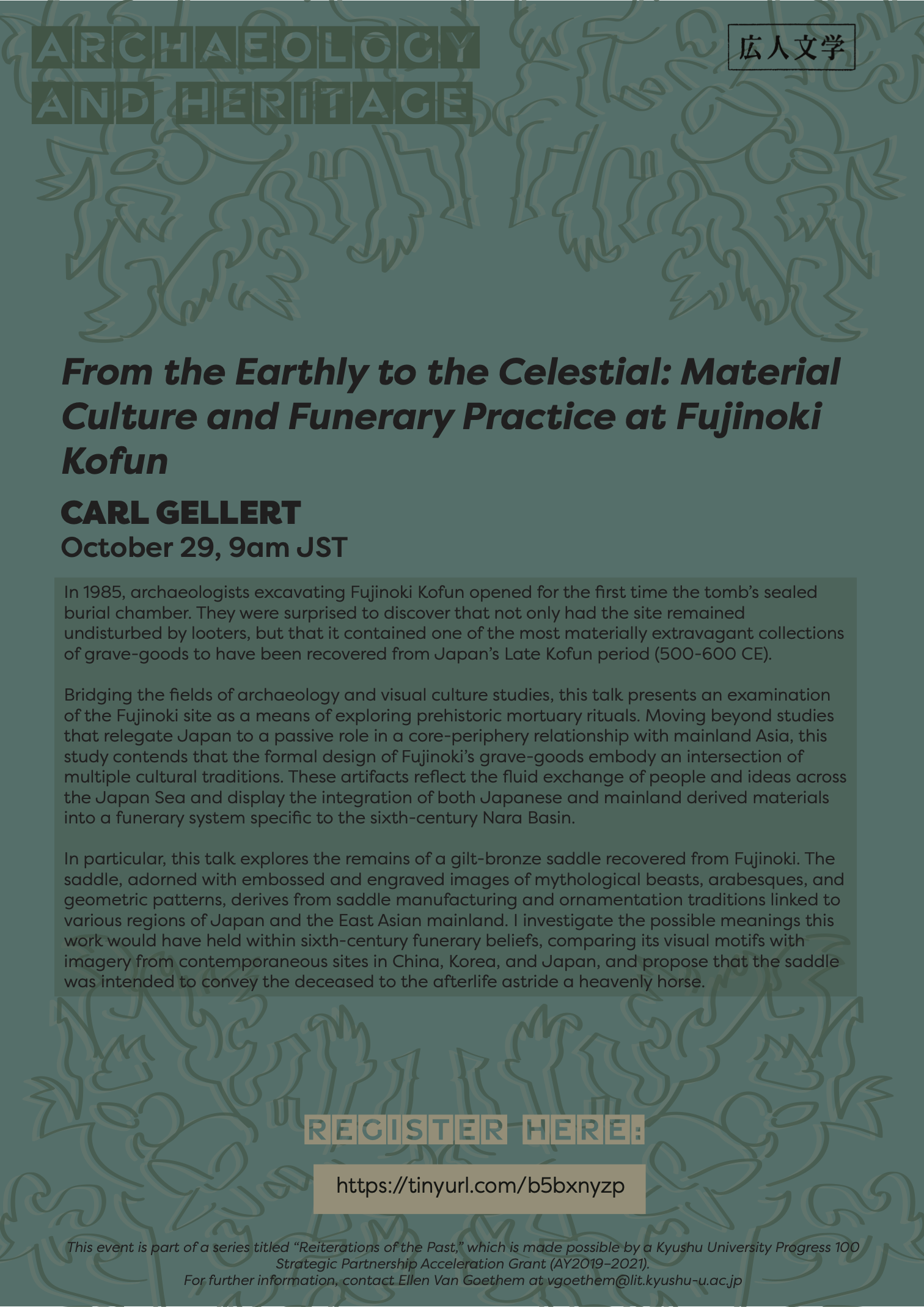
Carl Gellert, “From the Earthly to the Celestial: Material Culture and Funerary Practice at Fujinoki Kofun”
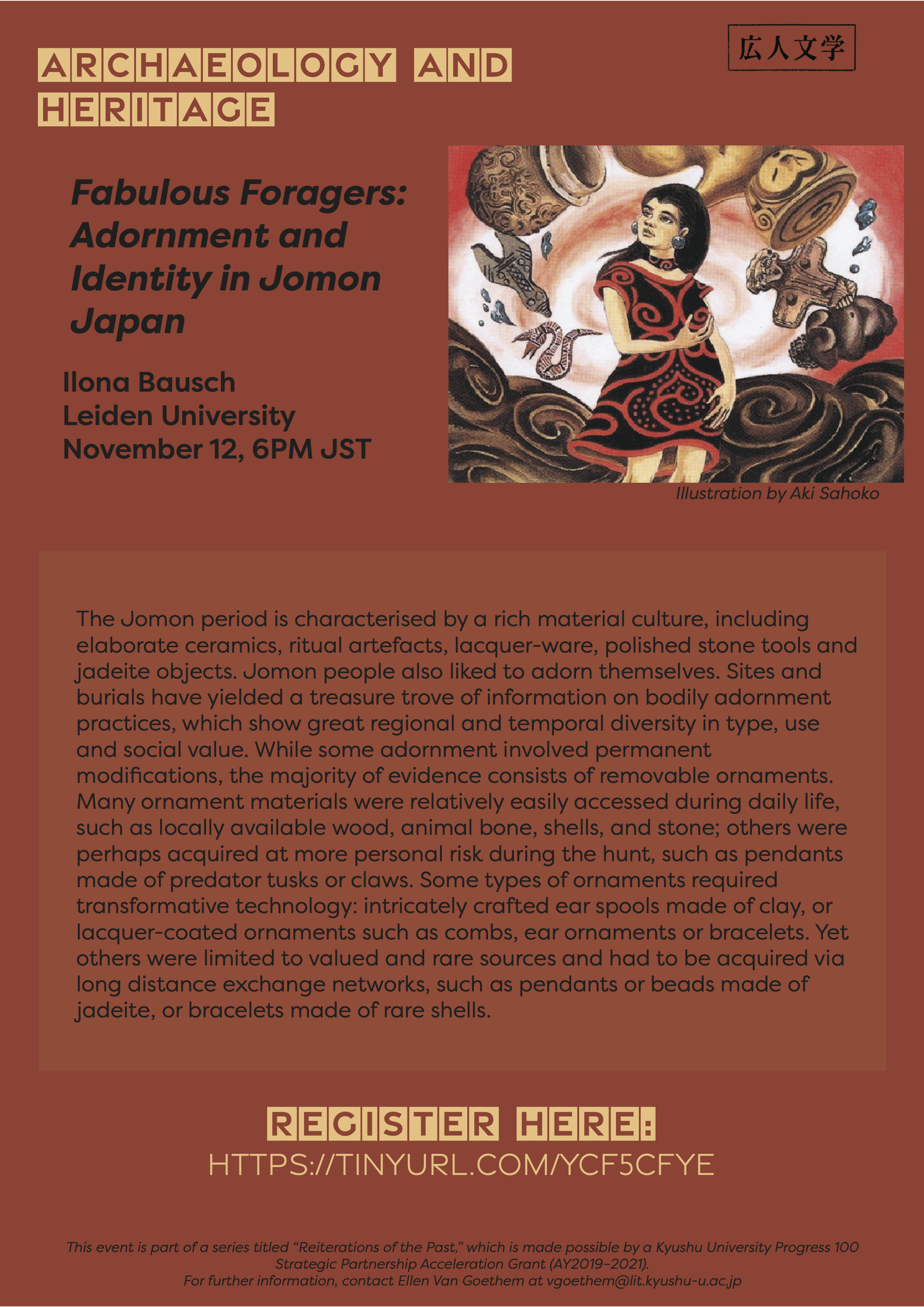
Ilona Bausch, “Fabulous Foragers: Adornment and Identity in Jomon Japan”
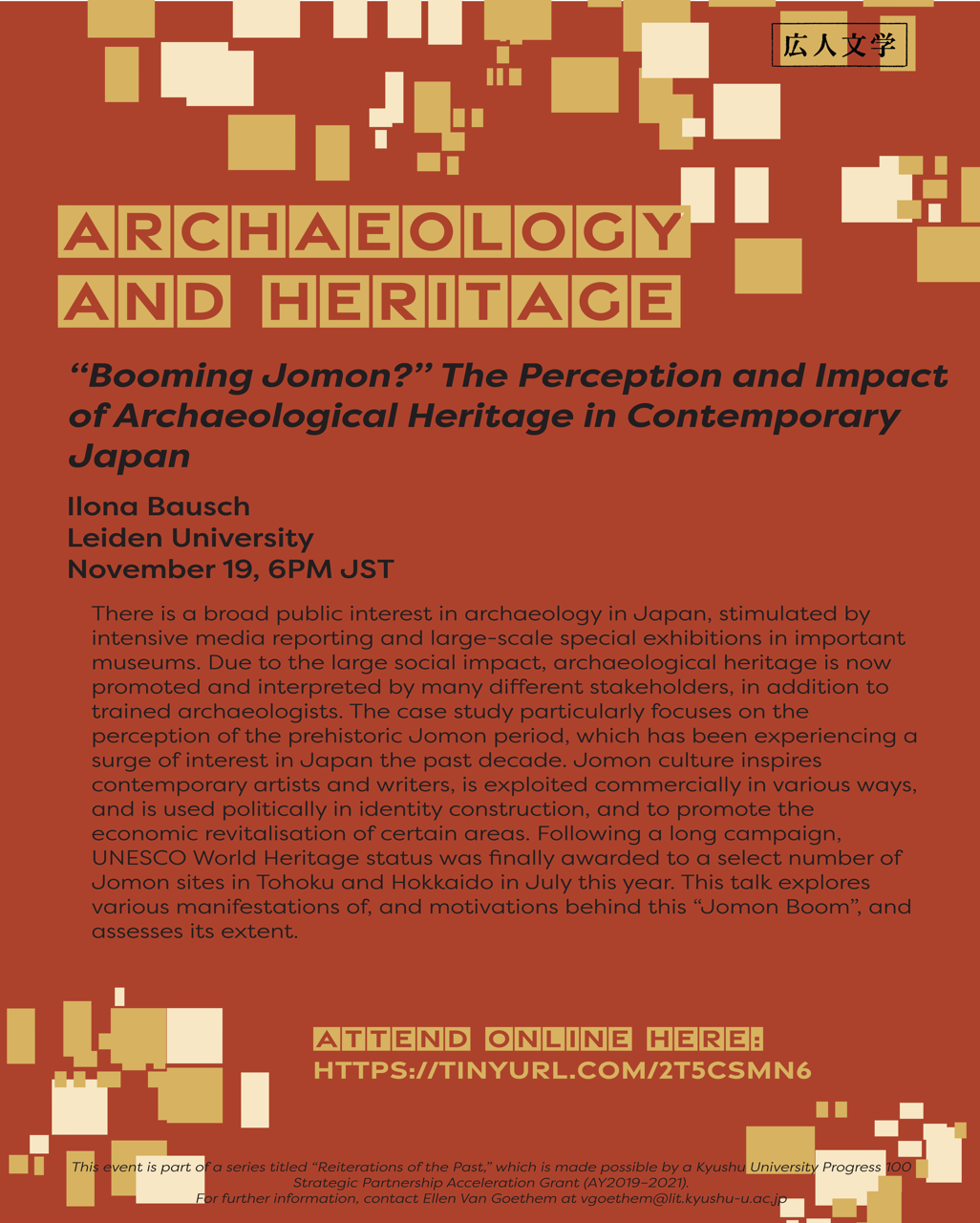
Ilona Bausch, “‘Booming Jomon?’ The Perception and Impact of Archaeological Heritage in Contemporary Japan”
Enrico Crema, “Archaeological Approaches to Prehistoric Demography”
Enrico Crema, “Towards a Synthetic and a Comparative Archaeology”
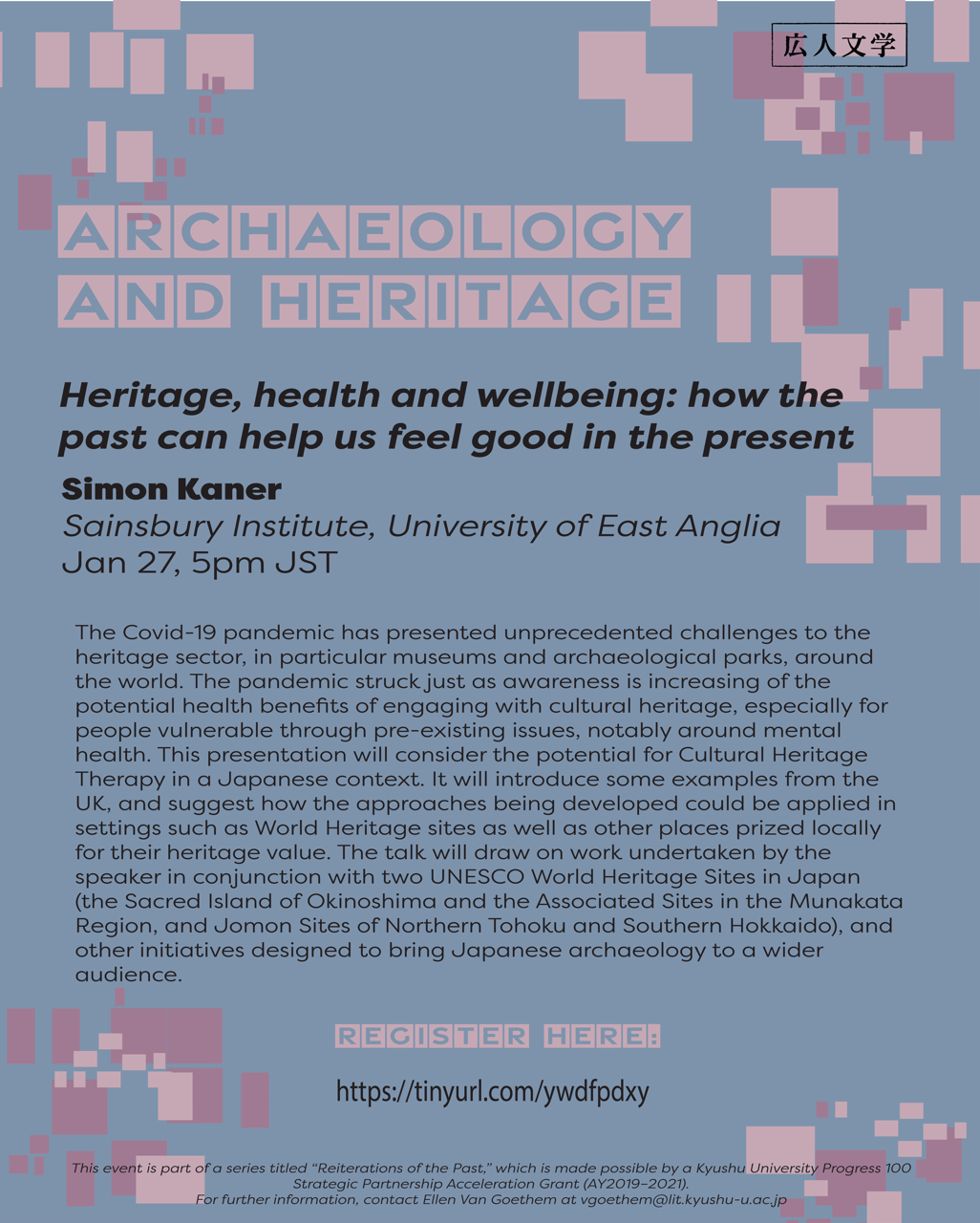
Simon Kaner, “Heritage, Health and Wellbeing: How the Past Can Help Us Feel Good in the Present”
Amanda Gomes, “Beyond Academia: Developing and Exploring Relationships between Archaeology and Communities”
Mark Hudson, “Archaeology Re-Writes the History of the Ryukyu Islands”
Japanese Religious Studies Behind the Scenes
In this series, co-organized with Caleb Carter, 19 scholars of Japanese religions shared their expertise on the methodological, ethical, and practical dimensions of conducting fieldwork and research in a rapidly evolving academic landscape. Moving beyond abstract theories, several of the lectures addressed the lived realities of being a researcher.
Jessica Starling, “Family, Gender and Access in Ethnographic Research”
Carina Roth, “Religious Itinerancies: The Example of Mizoku kuyō”
Barbara R. Ambros, “Doing Research during the Pandemic: Ritual Animal Releases in the Edo Period”
Shayne Dahl, “Anthropological Approaches to Religion in Japan”
Paulina Kolata, “On Running Networks: Making Sense of Rural Japan through Ethnography”
Hannah Gould, “Anthropologists ‘Studying Up’ and Working with (Religious) Industries in Japan”
Levi McLaughlin, “Covid Contingencies, the Corporate Form of Religion, and Hybrid (remote & in situ) Methods in the Field”
Emily B. Simpson and Or Porath, “Reading Premodern Japanese: Tips and Tricks”
Julia Cross, “Relic Worship, Nuns and Medieval Japan”
Ioannis Gaitanidis, “Analysing Rehearsed Life Stories: Spiritual Therapists, Local Phenomenologies of Religion and the Researcher’s ‘Responsibilities’”
Michael Dylan Foster, “Ethnographic Improvisation and The Study of Nenjū-gyōji”
Kaitlyn Ugoretz, “Ethnography of Japanese Religions Online: Methods for Bridging Digital Divides”
Erica Baffelli, “Working with Each Other’s Words: Collaborative Research and Co-Authorship”
Emily B. Simpson, “Writing Up the Research: Tips, Tricks and Time Management”
John Shultz, “Juicy Data: Ethical Conundrums in Social Scientific Fieldwork”
Duncan Reehl, “Sound and Music in the Ethnography of Japanese Religions”
Elisabetta Porcu, “Ethnography of Japanese Festivals from the Perspective of Woman Scholars: Gion Matsuri in Kyoto”
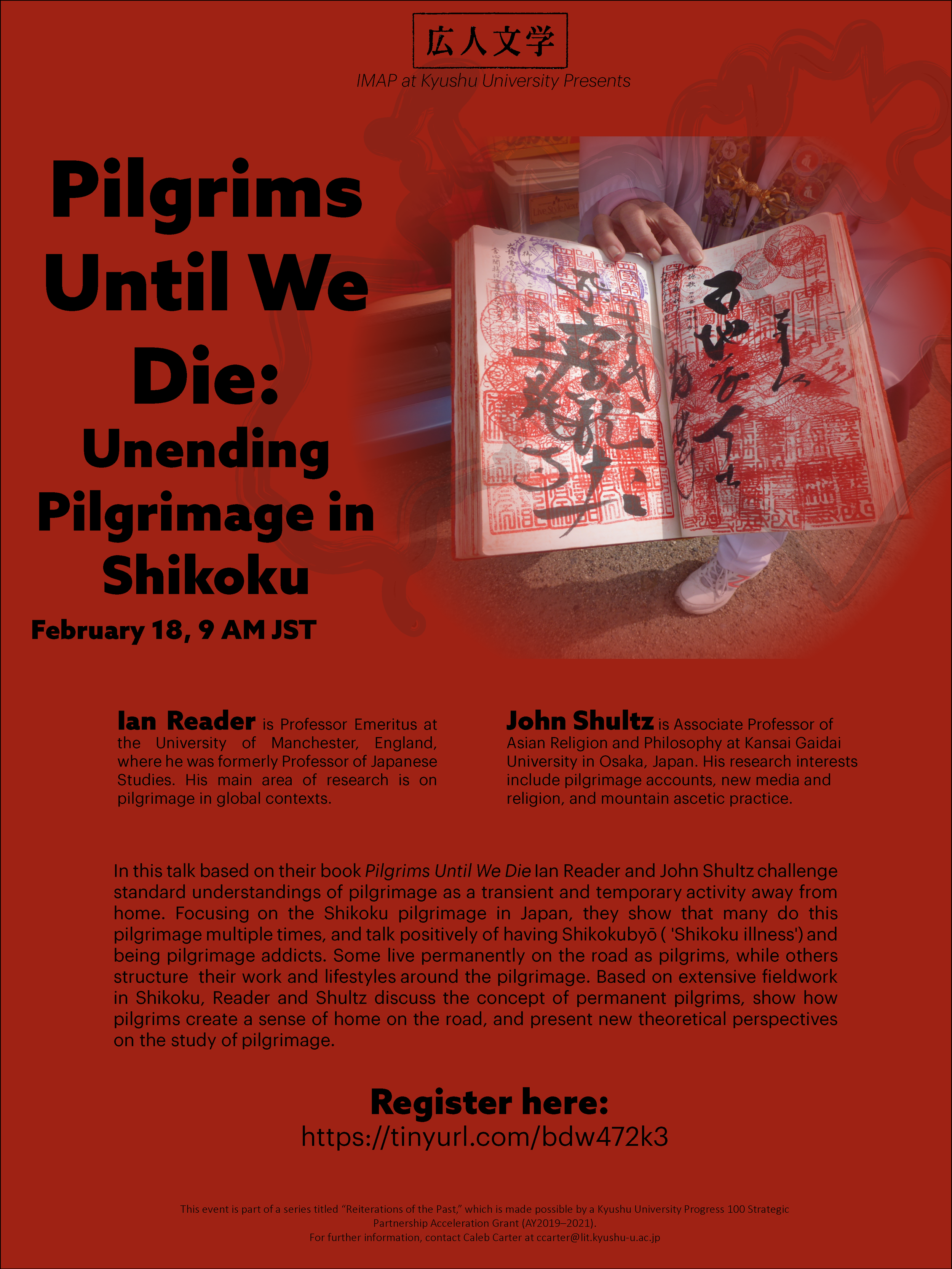
Ian Reader and John Shultz, “Pilgrims Until We Die: Unending Pilgrimage in Shikoku”
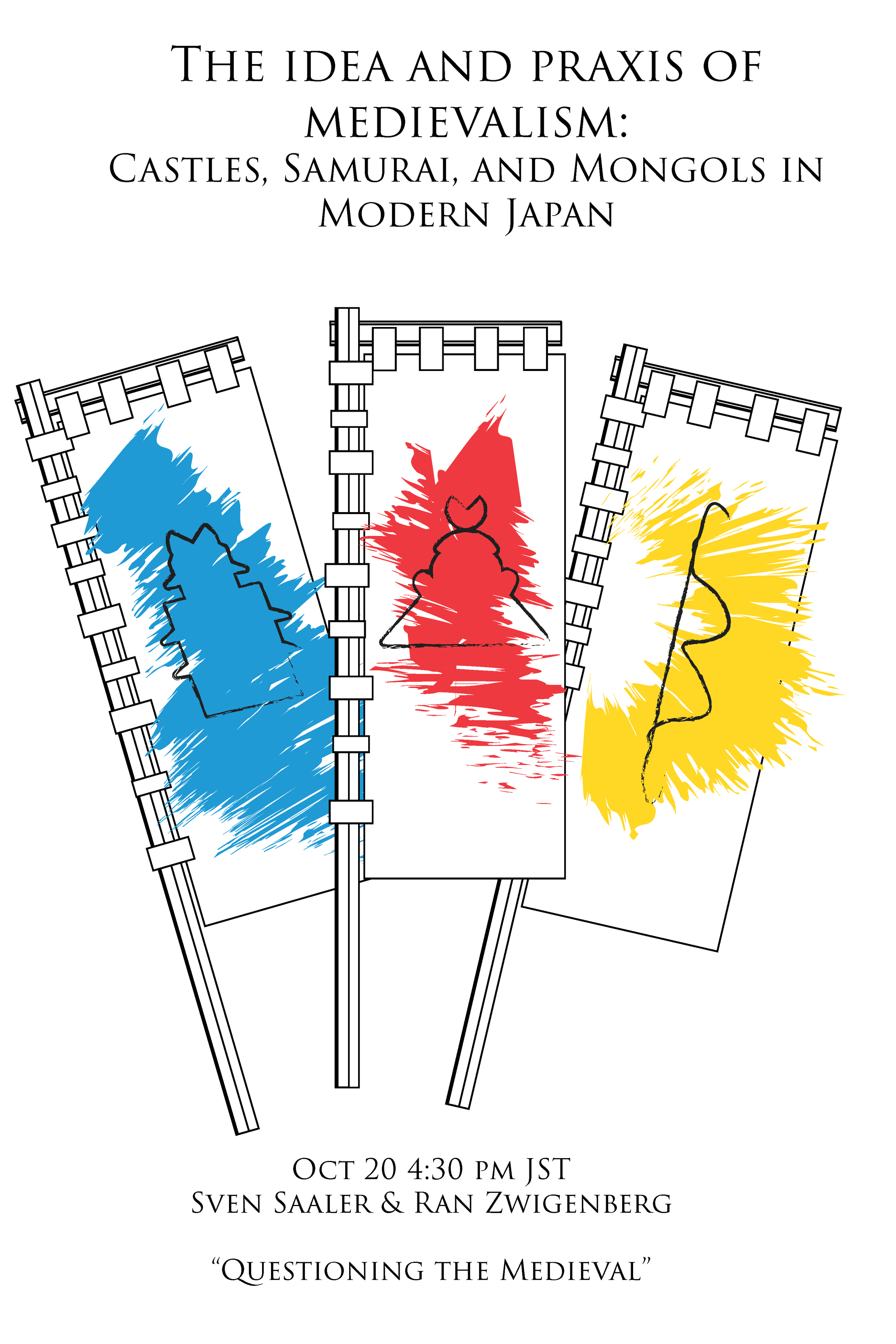
The Idea and Praxis of Medievalism:
Castles, Samurai, and Mongols in Modern Japan
The lecture series The Idea and Praxis of Medievalism: Castles, Samurai, and Mongols in Modern Japan, co-organized with Ran Zwigenberg, explores how modern Japan rebranded its medieval past.
Both at home and abroad, Japan’s castles serve as prominent symbols of local, regional, and national identity. Castles occupy the center of most major Japanese cities and are universally recognizable as sites of heritage and as a link to the nation’s past. The current prominence of castles obscures their troubled modern history. After the restoration of 1868, castles, no longer of immediate military significance, became symbols of authority, on one hand, and of vaunted tradition on the other. Castles were major sites of exhibitions, where they were often contrasted with Japan’s achievements in acquiring modern technology, serving as potent illustrations of wakon yōsai (Japanese spirit and Western technology). Castles were but one of the many sites, both physical and metaphorical, of dissemination of the “medieval” in modern Japan.
An import from the West, the notion of a medieval era (chūsei), and the “invertible” progress into modernity that followed, were supposed to endow Japanese history with the dignity and worth of a Europeanised history. Thus, the Warring States period (a term which was itself an import from China), was called the Japanese Wars of the Roses, samurai were termed knights, and bushido—a mostly 19th-century rehashing of earlier ideas—was made a Japanese form of chivalry. Such uses were directed at both international audiences and at domestic ones, as Japan sought a “usable past” for the purpose of nation-building.
Using Zwigenberg’s lectures on castles as its core, our series examined various aspects of modern “medievalism,” and aimed to reconsider narratives of continuity and change in modern Japan, examining the changing role of the medieval in Japan’s troubled politics of history. The seminar featured, in addition to Zwigenberg’s lectures, a series of guest lectures on topics like the Mongol invasion, bushido, Japanese bronze statuary, and explored a wide gamut of topics beyond castles and architecture.
Ran Zwigenberg and Sven Saaler, “Questioning the Medieval”
Tatiana Linkhoeva, “Medieval Mongolia in Interwar Japan”
Ran Zwigenberg, “Castles and Medievalism in the Imperial State”
David Weiss, “The God Susanoo and Korea in Japan’s Cultural Memory: Ancient Myths and Modern Empire”
Sven Saaler, “The Medieval Roots of Imperial Loyalty: The Cult of Kusunoki Masashige in Modern Japan”
Ran Zwigenberg and Oleg Benesch, “The Idea and Praxis of Medievalism: Castles, Samurai and Mongols in Modern Japan”
Oleg Benesch, “Japan and Global Medievalism”
Judith Vitale-Frohlich, “Remembering the Mongol Invasions in the Area of Hakata Bay, 18th to Early 20th Centuries”
Michael Wert, “The Medieval in Early Modern and Modern Martial Fantasies”
Michael Wert, “Politics of the Sword: Violence and Ideology on the Eve of the Meiji Restoration”
Ran Zwigenberg, “Hiroshima Castle and the Long Shadow of Militarism in Postwar Japan”
Ran Zwigenberg, “The Pericles of Tokushima: The Heisei Castle Boom and the Long Trajectory of Castles in Modern Japan”
Religion in Manga, Anime and Popular Media
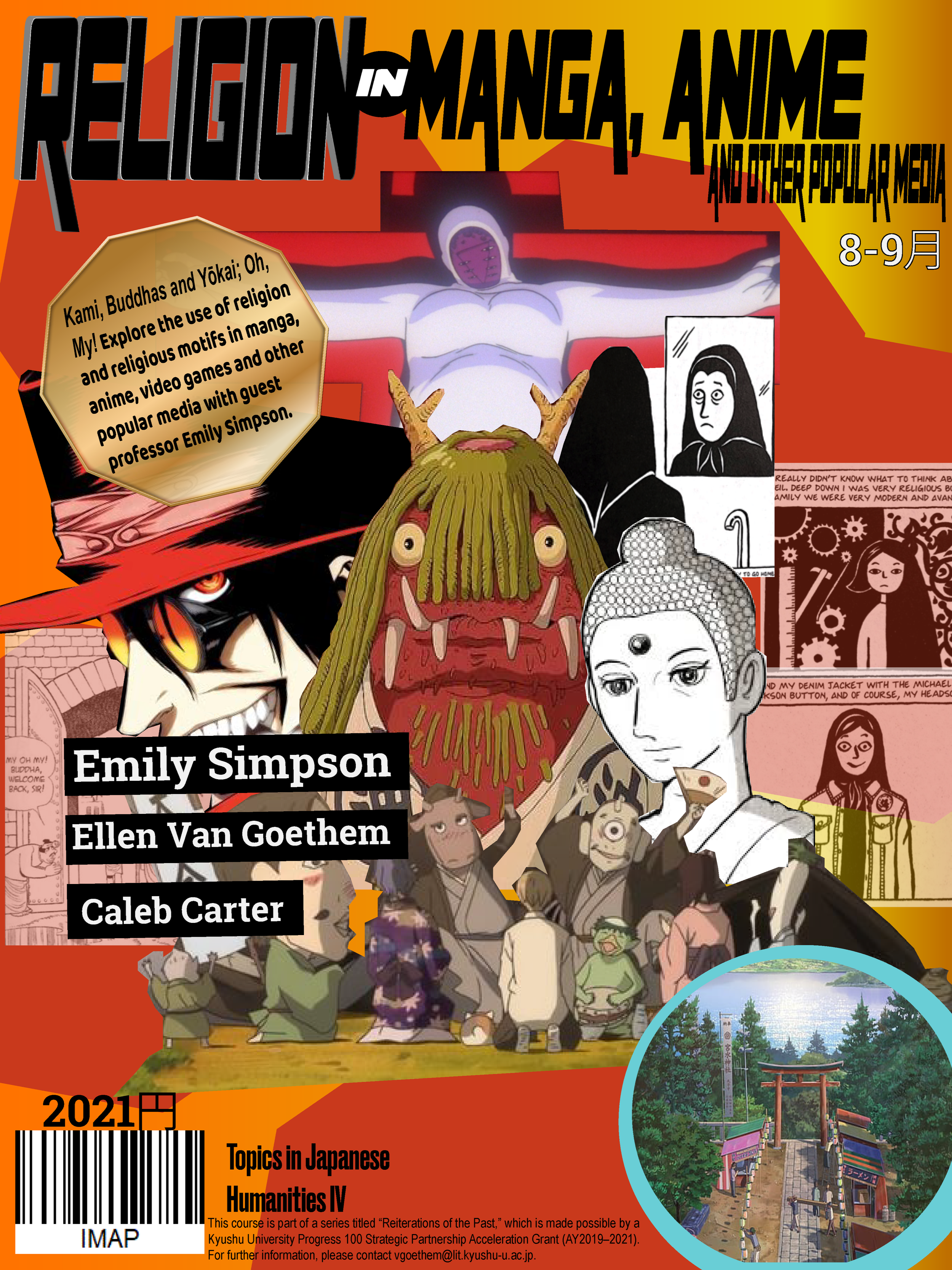
Over the course of 7 lectures, Emily B. Simpson explored the role, use and interpretation of different religious traditions (Shinto, Buddhism, Christianity/Judaism, and Islam) as well as key concepts (supernatural beings, other worlds) within largely—but not exclusively—Japanese manga, anime, video games, and other visual and digital media.
Religion in manga and anime often calls to mind the shrines, deities and mischievous spirits (yōkai) associated with Shinto and folk religion in Japan, featured prominently in several popular Studio Ghibli films and the 2016 international blockbuster Your Name. Buddhism also appears prominently, from Osamu Tezuka’s famous Buddha to Saint Young Men, which features Jesus and Buddha as roommates experiencing day-to-day life in Tokyo. But as the latter title suggests, interpretations and adaptations of religious figures, narratives, concepts and practices in popular media are rather complex and go beyond individual religions.
In this course, we explored how a variety of manga, anime, video games and other media portray religion in Japan, across the globe, and in fictional worlds. Yes, we read manga and watched anime for this class, but we also drew course materials from textbooks on diverse religions and scholarly articles on the portrayal of religious themes in popular media in Japan and elsewhere.